
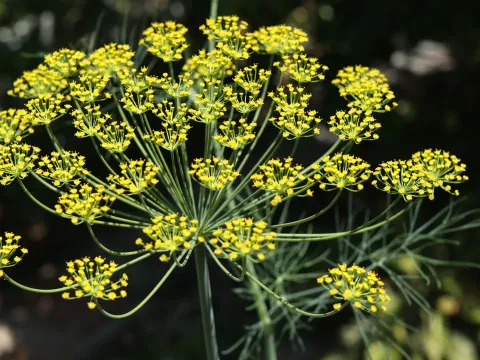
Indian dill
Anethum sowa
Indian dill (Anethum sowa) is an annual herbaceous plant belonging to the Apiaceae family. It is distinct from the common dill, primarily due to its different chemical profile and its adaptation to warmer, tropical climates.
What the section contains
Indian dill
Sowing should take place in well-drained, fertile soil during the warm season. In its primary growing regions, it is typically sown at the beginning of the rainy season or in the cooler period to ensure consistent germination.
The seeds are sown at a depth of 1-2 cm, with row spacing maintained at 30-40 cm to allow for proper airflow and development. Adequate moisture at the germination stage is critical for uniform field emergence.
Due to the small size of the seeds, a fine seedbed is essential to ensure good soil-to-seed contact. Using high-quality, treated seeds can significantly reduce the risk of seedling blight.
The crop is highly branching, which provides excellent ground cover once established. Proper plant spacing is vital to prevent competition for sunlight and nutrients during the rapid growth phase.
Indian dill requires full sun to thrive and produce high-quality essential oils. Any shade during the growing cycle can negatively impact the biomass quality and the oil content in the seeds.
The ideal soil type is sandy loam or light silt with a neutral pH level. Good drainage is non-negotiable, as stagnant water is the primary cause of root-related diseases in this aromatic crop.
The plant performs best in a temperature range of +20°C to +28°C. Extreme heat may trigger early bolting, which is undesirable if the goal is to harvest leafy biomass rather than seeds.
Irrigation should be consistent but moderate. Over-watering can lead to rapid decay of the foliage and invites fungal pathogens that can destroy the crop in a very short time.
Balanced fertilization is necessary, with a focus on phosphorus and potassium to enhance seed development. Excess nitrogen should be avoided during the flowering stage to maintain oil quality.
The primary economic value of Indian dill lies in its seeds, which are distilled to produce essential oils used extensively in the pharmaceutical and flavoring industries.
Biomass production for fresh herb harvest can yield between 15 and 25 tonnes per hectare, depending on irrigation management and variety selection. Harvesting for greens must be done before flowering.
For seed production, the crop is harvested once the seeds turn a mature brown color. Timing is critical, as over-ripeness leads to significant harvest loss due to the seeds shattering in the field.
Yields for seeds generally range from 800 to 1,500 kilograms per hectare. Proper post-harvest drying is required to stabilize the seeds and prevent mold growth during storage.
Efficiency in harvesting is often achieved through mechanization, using specialized combine harvesters that are adjusted to handle the delicate nature of the dried seed heads.
The crop is susceptible to various fungal diseases, including powdery mildew and root rot, which are often encouraged by high humidity and poor circulation in the crop canopy.
Pests such as aphids and the celery moth can severely damage the plant by feeding on the tender parts and flower buds, leading to stunted growth and reduced yields of essential oils.
Crop rotation is the most effective management strategy; the field should not be used for other Apiaceae family crops for at least 3-4 years to break the cycle of host-specific pathogens.
Integrated Pest Management (IPM) practices are highly recommended. This includes the use of beneficial insects and the targeted, restricted use of pesticides to ensure the safety of the final product.
Early detection of pests and diseases through field monitoring is essential. Maintaining a weed-free field also reduces the pressure from alternative hosts that can carry viruses to the dill crop.