
Creeping bush violet
Barleria repens
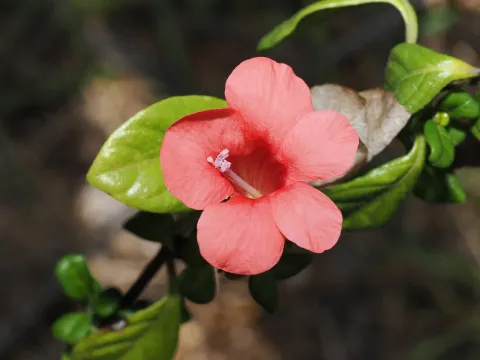
Barleria repens, commonly known as the creeping bush violet, is an evergreen subshrub belonging to the Acanthaceae family. Originating from the tropical regions of South Africa, it is widely recognized for its trailing growth habit and vibrant, trumpet-shaped flowers.
What the section contains
Creeping bush violet
Botanically, the plant features glossy, dark green foliage and blooms that can range in color from pink to deep magenta. Its stems are flexible and capable of rooting at the nodes when in contact with damp soil, making it a vigorous grower in suitable environments.
The plant thrives in bright, indirect light conditions. While it can tolerate partial shade, insufficient light levels will significantly reduce flowering intensity and cause the stems to become leggy, losing their compact, ornamental appearance.
Regarding climate requirements, the creeping bush violet prefers a warm and humid environment. It is not frost-tolerant and should be kept in temperatures above 15 degrees Celsius throughout the year to maintain optimal metabolic activity.
Soil quality is paramount for its development. A well-draining, nutrient-rich potting mix composed of loam, organic compost, and perlite or coarse sand is recommended to prevent waterlogging, which the plant's root system is particularly sensitive to.
Common pests affecting this culture include spider mites and mealybugs, which tend to congregate on the undersides of the leaves or in leaf axils. Frequent monitoring is essential, as these pests multiply rapidly in warm, dry indoor conditions.
Fungal issues, primarily root rot, occur when drainage is compromised or watering frequency is too high. Proper management of irrigation cycles and the use of pots with adequate drainage holes are the primary preventive measures against soil-borne pathogens.