
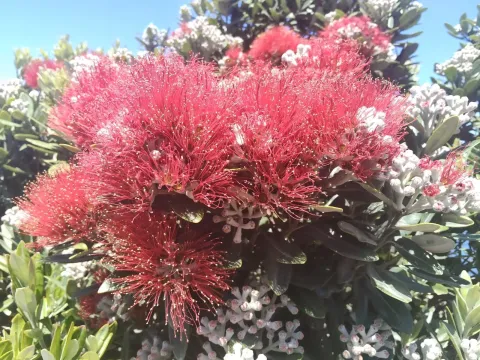
Metrosideros
Metrosideros Banks ex Gaertn.
Metrosideros is a genus of evergreen trees and shrubs belonging to the Myrtaceae family. These plants are widely recognized for their spectacular floral displays, featuring vibrant, brush-like stamens that provide significant ornamental value.
What the section contains
 Kermadec pōhutukawa
Metrosideros kermadecensis
Kermadec pōhutukawa
Metrosideros kermadecensis
 Metrosideros carminea
Metrosideros carminea
Metrosideros carminea
 Metrosideros colensoi
Metrosideros colensoi
Metrosideros colensoi
 Metrosideros collina
 (J. R. Forst. & G. Forst.) A. Gray
Metrosideros collina
Metrosideros collina (J. R. Forst. & G. Forst.) A. Gray
 Metrosideros diffusa
 (G. Forst.) Sm
Metrosideros diffusa
Metrosideros diffusa (G. Forst.) Sm
 Metrosideros parkinsonii
Metrosideros parkinsonii
Metrosideros parkinsonii
 Metrosideros perforata
 (J.R. et G. Forst.) A. Rich.
Metrosideros perforata
Metrosideros perforata (J.R. et G. Forst.) A. Rich.
 Metrosideros scandens
Metrosideros scandens
Metrosideros scandens
 New Zealand Christmas tree
Metrosideros excelsa Soland. ex Gaertn.
New Zealand Christmas tree
Metrosideros excelsa Soland. ex Gaertn.
 Northern Rata
Metrosideros robusta A. Cunn.
Northern Rata
Metrosideros robusta A. Cunn.
 Southern rata
Metrosideros umbellata
Southern rata
Metrosideros umbellata
 White-flowered metrosideros
Metrosideros albiflora
White-flowered metrosideros
Metrosideros albiflora
Metrosideros
Originating from the Pacific region, including New Zealand and Australia, these plants have adapted to various ecosystems, ranging from rugged coastal cliffs to lush rainforests. This adaptability makes them interesting subjects for botanical study and ornamental horticulture.
The cultivation of Metrosideros requires bright, diffused light for optimal growth and flowering. While they thrive in sunny environments, direct exposure to harsh afternoon sunlight, especially in glasshouses, must be managed to prevent leaf scorch.
A well-draining, nutrient-rich, and slightly acidic substrate is ideal for this culture. Proper drainage is essential, as the roots are highly sensitive to waterlogging, which often leads to rapid deterioration of the plant's health.
Climatic requirements focus on maintaining a moderate temperature range. Metrosideros is not frost-tolerant; therefore, cultivation in temperate regions requires protected conditions during colder months, ensuring temperatures remain above 10°C.
Typical pests affecting Metrosideros include spider mites, scale insects, and mealybugs. These pests frequently emerge when air humidity is too low or when plants are stressed by inconsistent watering regimes, necessitating proactive monitoring.
Fungal diseases, particularly root rots such as Phytophthora, pose a major threat. These conditions usually stem from excessive moisture in the root zone or poor ventilation, which encourages the development of pathogenic micro-organisms.
Effective management strategies include maintaining good air circulation and ensuring the growing medium dries slightly between waterings. Regular inspection of foliage, especially the undersides of leaves, helps in early detection of potential infestations.
Chemical control may involve the use of systemic insecticides for pest suppression and specialized fungicides for treating fungal infections. However, these should be used in conjunction with corrective cultural practices to ensure long-term plant vigor.
Furthermore, maintaining appropriate water quality is crucial to prevent mineral imbalances. Using soft or filtered water prevents the accumulation of salts in the soil, which can interfere with nutrient uptake and cause leaf yellowing.