
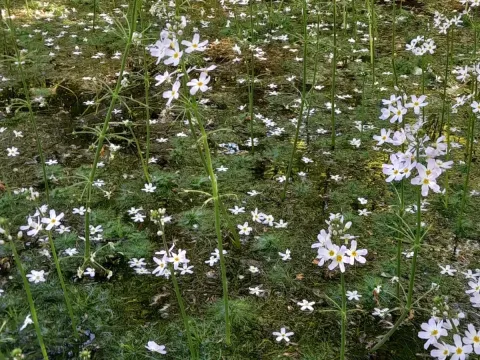
Hottonia
Hottonia
Hottonia is a genus of aquatic plants within the Primulaceae family. The most well-known species, Hottonia palustris, is widely distributed across Europe and Asia, where it thrives in wetlands, ponds, and slow-moving streams.
What the section contains

Hottonia
Botanically, Hottonia is a submergent plant characterized by its highly dissected, feathery leaves arranged in whorls along the stem. It performs an essential role in stabilizing the ecosystem by absorbing excess nutrients from the water column.
Successful cultivation requires moderate to high levels of light. If the lighting is insufficient, the plant will become leggy and lose its vibrant coloration. Consistent light intensity ensures compact and healthy growth of the feathery foliage.
The water chemistry should remain stable, with a preference for soft to medium-hard water and a slightly acidic to neutral pH. Hottonia thrives in temperatures ranging from 15°C to 25°C, making it suitable for unheated or temperate water environments.
For substrate, it prefers a nutrient-rich, fine-grained material that allows for easy root penetration. Regular water circulation is essential to prevent the accumulation of debris on the feathery leaves, which can otherwise block light and stunt development.
The primary threat to Hottonia is the infestation of filamentous algae. These algae thrive in conditions similar to the plant's preferences and can rapidly entangle the stems, effectively smothering the foliage and preventing photosynthesis.
Nutrient deficiencies, particularly involving iron and potassium, are common issues. These manifest as chlorosis or yellowing of the leaves, which, if left untreated, leads to tissue decay and the eventual collapse of the submerged stems.
Certain species of freshwater snails can cause mechanical damage to the delicate leaf structures. While moderate populations are usually fine, a sudden increase in snail numbers can lead to the rapid destruction of the plant's aesthetic quality.
Bacterial rot is a significant concern if there is stagnant water around the root zone. Once the infection starts in the stem, it progresses rapidly, often necessitating the pruning of healthy tops for propagation and the removal of affected parts.
Sudden environmental shifts, such as large water changes or temperature spikes, act as stressors. These changes often trigger leaf shedding, requiring a period of acclimatization to help the plant recover its normal growth rate and appearance.