
Water violet
Hottonia palustris
Description
Growing requirements
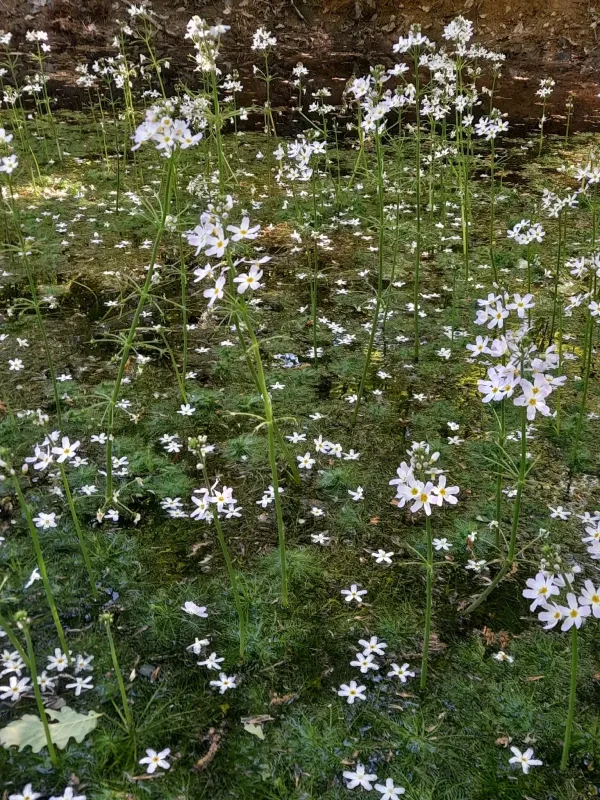
Hottonia palustris, commonly known as water violet, is a submerged perennial plant belonging to the Primulaceae family. It is native to Europe and western Asia, where it thrives in shallow ponds, ditches, and stagnant water bodies.
Botanically, the plant features elongated stems submerged in water, adorned with finely divided, feathery leaves. These leaves act as efficient nutrient absorbers, contributing to the plant's rapid growth in nutrient-rich but clean aquatic environments.
To cultivate water violet successfully, one must maintain high-quality water conditions. The species prefers cool to moderate temperatures and requires clear, well-oxygenated water to prevent stem decay and stunted leaf development.
Light intensity plays a crucial role in the plant's health. While it can adapt to various light levels, bright indirect light is necessary for the plant to maintain its characteristic dense, bright green, or reddish-hued appearance.
In terms of growth medium, water violet does not require deep or nutrient-dense soil but prefers a light substrate where its roots can anchor. It is highly valued in the aquascaping community for its delicate, fern-like aesthetic.
Main diseases and pests
The primary threat to Hottonia palustris is the rapid proliferation of filamentous algae. Once these algae attach to the fine leaves, they effectively smother the plant, blocking the light required for photosynthesis.
Poor water circulation is a significant risk factor, leading to the accumulation of organic detritus. This environment fosters fungal infections, which manifest as white patches or slime on the submerged parts of the plant.
Freshwater snails often pose a challenge in home aquariums or small ornamental ponds. If left unchecked, these gastropods can consume the delicate leaf tips, severely weakening the stem structure over time.
Nutrient imbalances, particularly low iron levels, are common issues. When essential micronutrients are missing, the plant shows visible signs of chlorosis, leading to transparent leaves and eventual stem breakage.
Drastic changes in water parameters, such as sudden shifts in pH or hardness, can cause the plant to drop its leaves or enter a state of dormancy. Consistency is the key to maintaining a thriving population.