
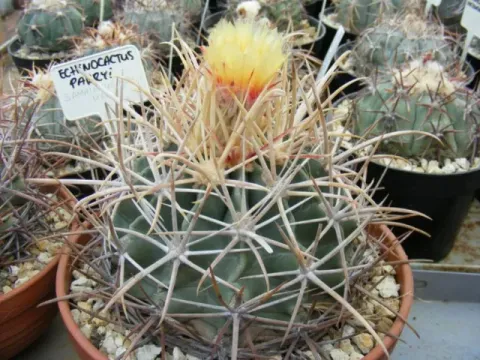
Echinocactus parryi
Echinocactus parryi
Echinocactus parryi is a distinct member of the Cactaceae family, native to the arid desert regions of Chihuahua, Mexico. This slow-growing succulent is highly adapted to harsh, dry climates, featuring a thick, spherical stem protected by robust, radial, and central spines.
What the section contains
Echinocactus parryi
Botanically, the species is recognized for its dense apical wool which serves as a protective mechanism against extreme solar radiation in its natural habitat. The stem exhibits deep ribs that allow the plant to expand during rare rainfall events and shrink during prolonged droughts.
The cultivation of this plant requires full sun exposure to maintain its compact shape and healthy spine production. In a controlled greenhouse or indoor environment, artificial supplementation may be necessary if natural light levels are insufficient during the growing season.
A strictly mineral-based substrate is essential for Echinocactus parryi to thrive. The soil mix should prioritize drainage, consisting primarily of pumice, coarse sand, and crushed limestone, avoiding organic matter that could retain moisture and cause root issues.
Temperature management is a key factor in the plant's health. While they can tolerate high summer heat, the winter cycle must include a significant drop in temperature to 5–10 degrees Celsius. This dormancy period, accompanied by total water deprivation, is vital for future blooming.
The primary threat to this species is overwatering, particularly during the dormant winter phase. Moisture retention in the soil frequently leads to root rot, which often spreads to the vascular tissue of the stem before it becomes visible on the surface.
Pest management involves regular monitoring for mealybugs, which thrive in the crevices between ribs and underneath the apical wool. Spider mites are also a threat, typically occurring in conditions of extreme dryness and poor air circulation within the growing area.