
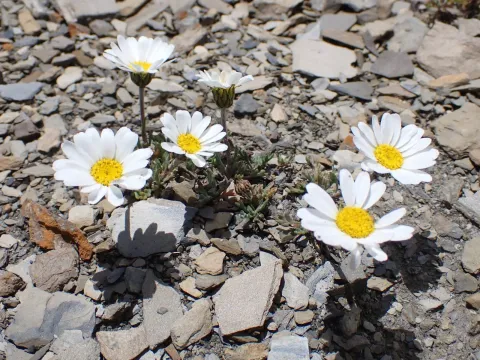
Leucanthemopsis
Leucanthemopsis
Sowing of Leucanthemopsis seeds is primarily conducted in the spring when the soil warms up to stable temperatures. The optimal time is considered to be April or early May, when the risk of late frosts is minimized.
What the section contains


Leucanthemopsis
To accelerate flowering, growing the plant from seedlings in a greenhouse is possible. Sowing in individual trays is carried out in March, ensuring the seeds receive sufficient diffused light for normal seedling development.
When sowing directly into open ground, seeds are planted at a shallow depth of no more than 0.5–1 cm, as they require good oxygen access. Substrate moisture must be uniform without compacting the top layer of soil.
Shoots usually appear 2–3 weeks after sowing, provided the air temperature is maintained around 18–20 degrees Celsius. It is important to keep the area free of weeds, which can suppress the growth of young plants at the initial stage.
Seedling transplanting is performed when two true leaves have formed. Hardened plants are planted in their permanent location with an interval of 20–30 cm to provide enough space for the plant to form a compact bush.
Leucanthemopsis belongs to the Asteraceae family and grows naturally in mountainous regions of Europe. This perennial plant is valued for its high ornamental quality and its ability to adapt to nutrient-poor soils.
The crop prefers well-lit areas with direct sunlight. Under conditions of heavy shade, stems become elongated, lose their compactness, and the intensity of flowering is significantly reduced.
The soil for cultivation should be light, well-drained, and have a neutral or slightly alkaline pH. The plant reacts extremely negatively to stagnant moisture, so on heavy clay soils, high-quality drainage is mandatory.
Leucanthemopsis has high requirements for temperature stability. It thrives in high-altitude conditions, so in flat landscapes, it is important to provide protection against winter rot caused by dampness.
Irrigation should be moderate and regular during prolonged droughts. Excessive application of nitrogen fertilizers is not recommended, as it leads to excessive vegetative mass at the expense of flower quality and overall plant hardiness.
Leucanthemopsis has natural immunity to many diseases, but under improper care, it may be affected by fungal pathogens. Root rot, caused by excessive soil moisture, is the most dangerous threat.
Powdery mildew can manifest in high-humidity conditions with poor airflow. Control measures include thinning the plants and using appropriate fungicides to treat the foliage.
Among pests, aphids and spider mites are the most dangerous as they feed on the sap of young leaves. Regular visual monitoring of plant condition helps prevent their rapid spread.
Slugs and snails can cause serious damage to young shoots during rainy seasons. It is recommended to use barrier protection methods or specialized molluscicide granules to minimize losses.
Disease prevention consists of adhering to agricultural standards: proper planting density and avoidance of excessive moisture. A healthy microclimate significantly reduces the need for chemical protection agents.
In ornamental gardening, harvesting Leucanthemopsis refers to collecting seeds if further propagation is planned. Seed ripening is uneven, so collection is performed in several stages.
It is recommended to collect seeds during dry weather when the flower heads begin to dry and turn brown. After collection, the material must be dried in a ventilated, dark place, then extracted from the heads.
To maintain the aesthetic look of the flower bed throughout the season, sanitary pruning of dead flower heads is performed. This stimulates the plant to flower again and prevents energy depletion on poor-quality seeds.
In autumn, after the vegetation period ends, the aerial part of the plants is often cut back to a height of 5–10 cm above ground level. This promotes better winter survival of the bush and prevents pathogen accumulation on old stems.
Cleaning the area of plant debris is a mandatory step in winter preparation. Collected biomass can be composted if no disease signs are found, or disposed of to prevent the spread of pests.