
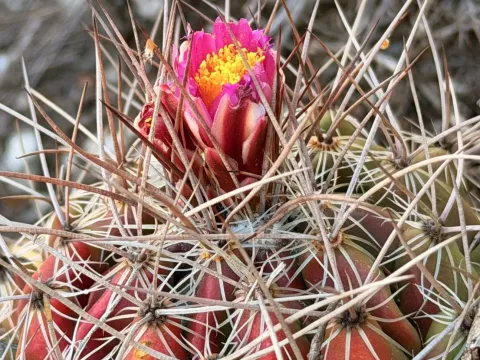
Hamatocactus
Hamatocactus
Sowing Hamatocactus seeds is best performed during the spring season, from March to May, when increasing day length stimulates natural germination processes.
What the section contains


Hamatocactus
A well-draining substrate composed of peat and sharp sand must be sterilized before use to prevent the damping-off disease common in succulent seedlings.
The seeds should be sown on the surface and pressed lightly into the soil, covered with a glass lid to maintain high humidity within the germination container.
A steady temperature of 22–25 degrees Celsius is essential for maintaining uniform germination rates across the entire batch of seeds.
Once the seedlings develop their characteristic spines, the covering must be removed gradually to acclimatize the young plants to lower humidity levels.
Hamatocactus belongs to the Cactaceae family and is native to arid regions of Mexico and the southern United States, thriving in rocky, well-draining soils.
This crop requires intense, direct sunlight to maintain its compact, ribbed form and to encourage the production of its vibrant, characteristic blooms.
Watering practices should be strict: the substrate must dry out completely between waterings to simulate the plant's natural desert habitat cycles.
During the winter rest period, the plants should be kept in a cool, bright location with temperatures around 10–12 degrees Celsius to facilitate flowering.
The soil mixture should be predominantly mineral, incorporating perlite, coarse sand, and a small amount of organic matter to provide optimal aeration and nutrient availability.
Spider mites are the most prevalent pest for Hamatocactus, often colonizing the areas between the ribs when ambient humidity remains too low for extended periods.
Mealybugs can also infest these cacti, causing significant damage by sap-sucking, which leads to stunted growth and increased susceptibility to secondary infections.
Root rot is a critical threat typically caused by excessive watering or poor soil drainage, which creates an anaerobic environment fatal to the plant's roots.
To combat fungal pathogens, it is recommended to apply systematic fungicides and ensure that the plants are kept in an area with good air circulation.
Mechanical removal of pests using cotton swabs dipped in isopropyl alcohol is an effective non-chemical solution for light infestations discovered early.