
Catopsis
Catopsis
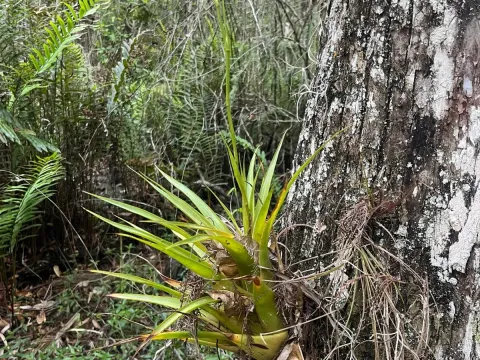
Catopsis is a genus of perennial herbaceous plants belonging to the Bromeliaceae family. These plants are primarily epiphytes, meaning they typically grow on the branches or trunks of trees in their natural tropical habitats rather than rooting in the ground.
What the section contains


Catopsis
The native distribution of Catopsis spans across the tropical regions of Mexico, Central America, the Caribbean, and northern South America. Some species are also found in the southern parts of Florida, preferring humid, forest-like environments where rainfall provides constant moisture.
The botanical structure of Catopsis is characterized by a dense rosette of leaves that forms a central tank. This tank serves as a biological reservoir, capturing rainwater, debris, and insects, which the plant utilizes as a source of nitrogen and other essential nutrients through its leaves.
Cultivating Catopsis successfully requires mimicking its natural epiphytic environment. This involves maintaining high ambient humidity levels and providing bright, indirect light. Unlike soil-grown crops, these plants need a specialized airy medium, such as bark or sphagnum moss, to prevent root rot.
In terms of agricultural or economic use, Catopsis is primarily valued as an ornamental specimen in greenhouses and botanical collections. It is not an edible or industrial crop, but it plays a significant role in studies of plant-insect interactions and unique evolutionary adaptations of tropical flora.
The primary threats to Catopsis in a controlled environment are fungal and bacterial infections caused by poor air circulation. Stagnant water within the leaf rosette, especially in combination with cool temperatures, often leads to crown rot, which can quickly prove fatal to the specimen.
Pest management focuses on common tropical plant invaders, specifically mealybugs and scale insects. These pests often hide in the tight crevices of the leaf bases, making them difficult to control. Regular inspection and the use of insecticidal soaps are recommended to maintain plant health.