
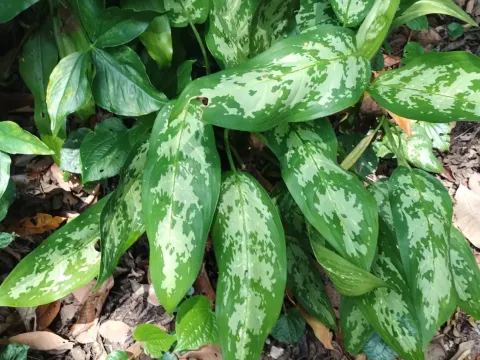
Aglaonema
Aglaonema Schott.
Aglaonema (genus Aglaonema Schott) is a member of the Araceae family, native to the tropical rainforests of South and Southeast Asia. These evergreen perennials are highly valued in both commercial horticulture and interior landscaping for their striking foliage and adaptability.
What the section contains
 Aglaonema brevispathum
 (Engl.) Engl.
Aglaonema brevispathum
Aglaonema brevispathum (Engl.) Engl.
 Aglaonema commutatum
 Schott x Aglaonema crispum (Pitcher & R. F. Manda) Nicolson
Aglaonema commutatum
Aglaonema commutatum Schott x Aglaonema crispum (Pitcher & R. F. Manda) Nicolson
 Aglaonema commutatum
 Schott
Aglaonema commutatum
Aglaonema commutatum Schott
 Aglaonema commutatum
 Schott x Aglaonema philippinense Engl. var. stenophyllum (Merr.) R. N. Jervis
Aglaonema commutatum
Aglaonema commutatum Schott x Aglaonema rotundum N.E.Br.
Aglaonema commutatum
Aglaonema commutatum Schott x Aglaonema philippinense Engl. var. stenophyllum (Merr.) R. N. Jervis
Aglaonema commutatum
Aglaonema commutatum Schott x Aglaonema rotundum N.E.Br.
 Aglaonema costatum
 N. E. Br.
Aglaonema costatum
Aglaonema costatum N. E. Br.
 Aglaonema crispum
 (Pitcher & R. F. Manda) Nicolson
Aglaonema crispum
Aglaonema crispum (Pitcher & R. F. Manda) Nicolson
 Aglaonema hybrid
Aglaonema rotundum N. E. Br. x Aglaonema simplex (Blume) Blume
Aglaonema hybrid
Aglaonema rotundum N. E. Br. x Aglaonema simplex (Blume) Blume
 Aglaonema nitidum
 (Jack) Kunth
Aglaonema nitidum
Aglaonema nitidum (Jack) Kunth
 Aglaonema philippinense var. stenophyllum
Aglaonema philippinense Engl. var. stenophyllum (Merr.) R. N. Jervis
Aglaonema Rotundum Philipinense
Aglaonema rotundum N. E. Br. x Aglaonema philippinense Engl. var. stenophyllum (Merr.) R. N. Jervis
Aglaonema philippinense var. stenophyllum
Aglaonema philippinense Engl. var. stenophyllum (Merr.) R. N. Jervis
Aglaonema Rotundum Philipinense
Aglaonema rotundum N. E. Br. x Aglaonema philippinense Engl. var. stenophyllum (Merr.) R. N. Jervis
 Aglaonema simplex
 (Blume) Blume
Aglaonema simplex
Aglaonema simplex (Blume) Blume
 Aglaonema simplex brevispathum
Aglaonema simplex (Blume) Blume x Aglaonema brevispathum (Engl.) Engl.
Philippine Aglaonema
Aglaonema nitidum (Jack) Kunth x A. philippinense Engl. var. stenophyllum (Merr.) R. N. Jervi
Philippine Aglaonema
Aglaonema philippinense Engl. var. stenophyllum (Merr.) R. N. Jervis x Aglaonema simplex (Blume) Blume
Aglaonema simplex brevispathum
Aglaonema simplex (Blume) Blume x Aglaonema brevispathum (Engl.) Engl.
Philippine Aglaonema
Aglaonema nitidum (Jack) Kunth x A. philippinense Engl. var. stenophyllum (Merr.) R. N. Jervi
Philippine Aglaonema
Aglaonema philippinense Engl. var. stenophyllum (Merr.) R. N. Jervis x Aglaonema simplex (Blume) Blume
 Round-leaf Aglaonema
Aglaonema rotundum N.E.Br.
Spotted Evergreen
Aglaonema costatum N. E. Br. forma costatum
Round-leaf Aglaonema
Aglaonema rotundum N.E.Br.
Spotted Evergreen
Aglaonema costatum N. E. Br. forma costatum
Aglaonema
Botanically, Aglaonema plants feature short, erect stems and large, lance-shaped leaves. Many varieties exhibit attractive variegation, including shades of silver, white, pink, or red. This genetic diversity allows for numerous cultivars that are popular in global markets.
The crop requires specific climatic conditions, primarily warmth and high humidity. It performs best in temperatures ranging from 20 to 25 degrees Celsius. In cultivation, it is essential to provide bright, indirect light, as direct sun exposure can scorch the foliage.
Soil management for Aglaonema focuses on drainage and aeration. A well-draining substrate, typically consisting of peat moss, pine bark, and perlite, is ideal. The pH should be slightly acidic to neutral to ensure optimal nutrient uptake and prevent root development issues.
Aglaonema serves a significant economic role as a major indoor decorative crop. Beyond its aesthetic appeal, it is recognized for its ability to filter indoor pollutants, making it a staple in contemporary biophilic design for homes and offices worldwide.
Aglaonema is susceptible to several common pests, most notably mealybugs, scale insects, and spider mites. These pests thrive in dry environments and can cause significant sap loss, leading to leaf drop and decreased vigor of the plant.
Root rot caused by Pythium or Phytophthora species is the most critical agricultural threat to this crop. It is almost exclusively triggered by overwatering or poorly aerated soil conditions, leading to the rapid decay of the root system and plant collapse.
Fungal infections, such as Myrothecium leaf spot, often appear as irregular brown lesions on the leaves. These diseases spread rapidly in conditions of high humidity and poor ventilation, necessitating strict environmental control and the removal of infected plant tissue.
Bacterial blight can also affect Aglaonema, characterized by water-soaked spots that turn dark and necrotic. The spread of bacteria is often linked to overhead irrigation, which should be minimized in favor of targeted irrigation techniques to keep the foliage dry.
Integrated Pest Management (IPM) protocols are standard for professional growers, emphasizing sanitation and the use of systemic fungicides or insecticides when necessary. Regular monitoring of the growing environment is the primary strategy for ensuring a healthy, high-quality yield.