

Description
How to tell it apart
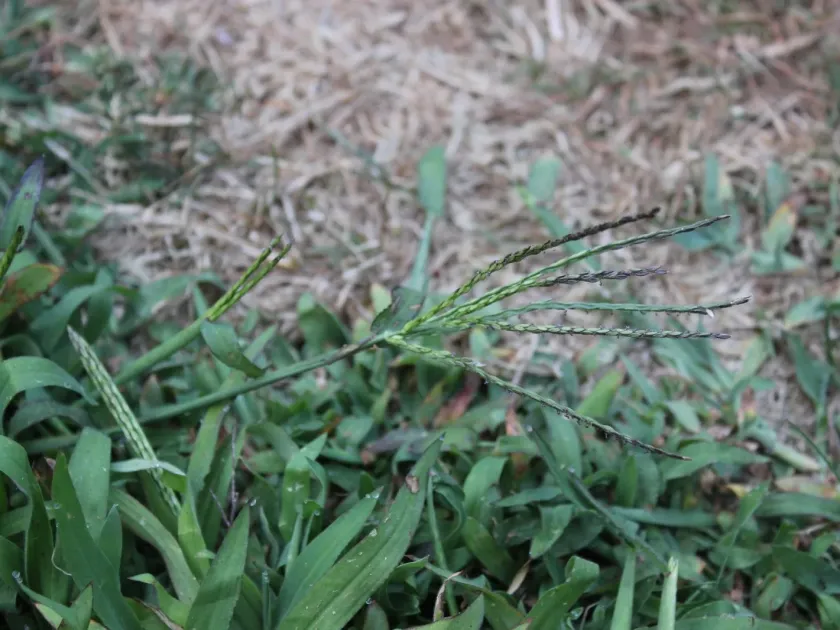
Large crabgrass (Digitaria sanguinalis) is an annual grass weed belonging to the Poaceae family. Its stems are often decumbent, spreading along the ground and rooting at the nodes, which allows it to form dense, mat-like colonies in fields.
The leaves are linear-lanceolate, covered with soft hairs, and often exhibit a reddish or purple tinge. The membranous ligule is a distinct diagnostic feature that helps distinguish this species from other annual grasses at the seedling stage.
The inflorescence consists of a digitate (finger-like) cluster of 3 to 9 spikes at the top of the stem. The plant produces massive amounts of seeds from mid-summer until late autumn, ensuring its dominance in disturbed soils.
Seeds are highly resilient and can remain viable in the soil for several years. A single mature plant can produce up to 150,000 seeds, which are easily transported by water, wind, or machinery, facilitating rapid colonization of new areas.
The root system is fibrous and quite vigorous. Its ability to root from stem nodes makes mechanical removal difficult, as even small fragments left in the soil can successfully regrow under favorable moisture conditions.
Where it grows
Large crabgrass thrives in warm, well-lit, and fertile environments. It is a problematic weed in row crops such as maize, soybeans, and various vegetable gardens where the soil surface is periodically disturbed or exposed.
It is commonly found along field edges, pathways, and in neglected pastures. The plant prefers loose, sandy, or loamy soils but can adapt to a wide range of soil textures provided there is sufficient light and warmth.
Germination typically begins when soil temperatures reach 15°C and above. In many agricultural systems, it is one of the first weeds to emerge in late spring, competing aggressively with slower-growing crop seedlings.
The weed is highly tolerant of drought once established, but it prefers moist soil for initial growth. It is particularly invasive in areas where irrigation or high fertilization practices are employed, as it quickly captures available nutrients.
Because it tolerates frequent mechanical soil movement, large crabgrass is a persistent problem in intensive cultivation systems. It excels in gaps within crop rows, effectively outcompeting desired plants for sunlight and growing space.
Harm it causes
The primary damage caused by large crabgrass is severe resource competition. By consuming large amounts of nitrogen and water, the weed significantly stunts the growth of crop plants, leading to substantial yield losses.
The dense mat of stems creates significant shade for younger crops. This competition for light is especially detrimental to low-growing vegetables and newly germinated field crops, often leading to reduced plant vigor and lower productivity.
Large crabgrass serves as an alternative host for various pests, including mites and aphids, and several viral and fungal diseases. These pathogens can easily spread from the weed to nearby high-value crop plants, complicating plant protection.
Weed seed contamination in harvested grain or vegetable produce reduces market quality and increases the cost of post-harvest cleaning and processing. This leads to direct financial losses for the producer.
In addition to yield reduction, the presence of this weed increases production costs. Farmers must invest in repeated manual or mechanical weeding and additional herbicide applications to keep the fields free of infestation.
How to control
Effective control requires an integrated approach. Cultural practices like deep plowing can bury seeds deep enough to prevent emergence, while timely mechanical inter-row cultivation is essential before the weeds establish root nodes.
Crop rotation remains a fundamental strategy. Planting dense canopy crops helps shade the soil surface, effectively suppressing crabgrass germination. Maintaining a healthy crop stand is one of the most cost-effective ways to minimize weed pressure.
Chemical control focuses on the use of pre-emergence herbicides to prevent germination and post-emergence graminicides applied at the early seedling stage (2–4 leaf phase). Timing is critical for ensuring chemical efficacy.
If large crabgrass has already formed dense mats, chemical treatment may be less effective. In such cases, a combination of mechanical weed management and targeted herbicide application is recommended to reduce the weed seed bank.
Ongoing monitoring is necessary throughout the growing season to catch early outbreaks. Combining soil-applied herbicides with rapid row closure strategies ensures that the crop maintains the competitive advantage over this aggressive weed species.
Content graph
Connections · Large crabgrass
Most often together:
Marketplace
Products · 122


Dublon Gold
ЗАТ Фірма Август, Росія.,селище Вурнари,
Herbicides
2
2
·
5.4K
6 offers
117.01 €per 1 l
Buy

Pantera
Кемарк КФТ, Угорщи (на замовлення Кемтура Корпорейшн, США)на
Herbicides
1
0
·
3.4K
27 offers
9 €per 1 l
Buy

Alfa-Prometrin
Zhejiang Zhongshan Chemical Industry Group Co., Ltd.
Herbicides
1
1
·
3K
22 offers
0.48 €per 1 l
Buy

Biceps Guarant
ЗАТ Фірма Август, Росія.,селище Вурнари,
Herbicides
0
0
·
2.4K
8 offers
0.63 €per 1 l
Buy

Quin Star
«Нанджин Ессенс Файн-Кемікал Ко. Лтд» (Китай)
Herbicides
2
0
·
2.3K
19 offers
1.83 €per 1 l
Buy


Miladar
«Нанджин Ессенс Файн-Кемікал Ко. Лтд» (Китай)
Herbicides
0
0
·
1.3K
15 offers
5.11 €per 1 l
Buy


Terramidin
Nanjing No.1 Pesticide Factory of Red Sun Group Co., Ltd.
Herbicides
0
0
·
1.1K
1 offer
7.61 €per 1 l
Buy


Consultant
Джянгсу Агрохем Лабораторі Ко. Лтд., Чанжоу, Китай
Herbicides
0
0
·
655
1 offer
5.68 €per pack
Buy

Targa Super, KE, herbicide
Nissan Chemical Corporation, LLC
Herbicides
0
0
·
110
1 offer
9.59 €per 1 l
Buy


Clotdym
«Shenyang Sciencreat Chemicals Co., Ltd», Shenyang, Liaoning, Китай
Herbicides
0
0
·
61
3 offers
6.32 €per 1 l
Buy


NICKOMIL, MS
China Chemical Industrial & Rice Co. Ltd
Herbicides
0
0
·
58
6 offers
0.89 €per 1 l
Buy


Oreol Maxi, CE
Jiangsu Institute of Ecomones Co., Ltd.
Herbicides
0
0
·
54
18 offers
6.07 €per 1 l
Buy


ANTI-ZLAK K.E.
Ф.Меатон Лімітед, Лондон, Великобританія.
Herbicides
0
0
·
54
2 offers
20.29 €per 1 l
Buy

CONSULTANT K.S., (NICOSULFURON 40 G/L)
Джянгсу Агрохем Лабораторі Ко. Лтд., Чанжоу, Китай
Herbicides
0
0
·
54
1 offer
5.9 €per 1 l
Buy


SAMSON Extra 6 OD
«Аріста ЛайфСайенс С.А.С.» , Франція
Herbicides
0
0
·
50
2 offers
23.15 €per 1 l
Buy


TIVITUS, VG (Rimsulfuron, 250 g/kg)
ТОВ «Фабрика агрохімікатів», Черкаси, Україна
Herbicides
0
0
·
48
5 offers
15.44 €per 1 l
Buy


Clodina, EC, herbicide
Лабораторіос Алкотан С.А., Севілья, Іспанія
Herbicides
0
0
·
47
2 offers
6.32 €per 1 l
Buy


Toplanz 240 EC
Фадер Альянс Лтд., Великобританія (Fader Alliance Ltd., England) на заводах Нідерландів, Польщі
Herbicides
0
0
·
45
2 offers
12.66 €per 1 l
Buy

Sulfonyl, VG, (Nicosulfuron, 750 g
Ф.Шаньдонг Цяочанг Кемікал Ко. Лтд.Китай.
Herbicides
0
0
·
45
4 offers
61.71 €per 1 l
Buy


Fusilade Forte 150 EC c.e.
Сингента Лімітед, Хаддерсфільд,Великоб-ританія
Herbicides
0
0
·
37
4 offers
27.56 €per 1 l
Buy

Quin Star Max
ТОВ «Фабрика агрохімікатів», Черкаси, Україна
Herbicides
0
0
·
36
21 offer
1.4 €per 1 l
Buy

Biology
Taxonomy
- Latin name
- Digitaria sanguinalis
- Family
- Однолетние злаковые