

Description
How to tell it apart
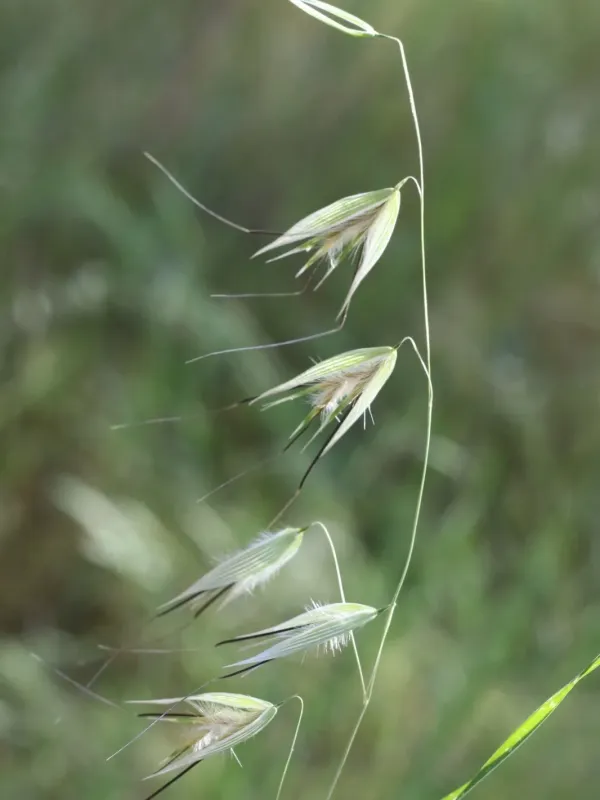
Wild oat (Avena fatua) is an annual grass weed from the Poaceae family. It is notorious for its morphological similarity to cultivated oats, making it difficult to distinguish until the inflorescence stage.
The plant grows up to 120 cm tall with a robust root system. Its leaves are broad, flat, and twisted counter-clockwise, which is a distinctive vegetative characteristic of the species.
The inflorescence is a loose, spreading panicle with drooping spikelets. Each spikelet contains twisted, bent awns that are sensitive to humidity, causing them to coil or uncoil in response to environmental moisture.
The seed (caryopsis) of the wild oat possesses a horseshoe-shaped scar at its base, a key feature that separates it from cultivated oat varieties during seed inspection processes.
Biologically, wild oat exhibits staggered seed germination. Seeds can remain viable in the soil seed bank for 5 to 7 years, allowing them to emerge from depths of up to 25 cm.
Where it grows
Wild oat is a cosmopolitan weed found in temperate regions worldwide. It thrives in fertile, well-drained soils, often becoming the dominant weed in high-production agricultural areas.
It is primarily a pest in spring-sown cereal crops, including wheat and barley. Because it shares the same ecological niche as these crops, it is exceptionally well-adapted to their life cycles.
Wild oat also infests pulse crops and oilseeds. It is frequently found along field margins, roadsides, and in fallow lands, where it serves as a source for spreading into cultivated fields.
Dispersal is largely facilitated by human activity, particularly through the use of contaminated crop seeds, as well as the movement of farm machinery across different land parcels.
Its ability to tolerate various environmental stresses allows it to establish permanent populations in fields where cropping patterns are not sufficiently diversified.
Harm it causes
The primary damage caused by wild oat is extreme resource competition. It aggressively absorbs soil moisture and nutrients, drastically reducing the vegetative vigor of the crop.
Yield losses can be significant, ranging from 20% to over 50% in heavily infested fields. Competition for light is especially intense due to the weed’s rapid early-season growth.
Wild oat acts as an alternative host for many cereal pathogens, including smut fungi, rusts, and various root-rotting organisms, which increases the disease pressure on the crop.
Contamination of harvested grain with wild oat seeds reduces market value and processing quality. This often results in heavy dockage at grain elevators and higher cleaning costs.
Its high reproductive potential, with a single plant producing up to 1,000 seeds, ensures the rapid expansion of the weed population, making long-term control a necessary management priority.
How to control
Integrated Weed Management (IWM) is essential for wild oat control. A well-planned crop rotation is the most effective cultural strategy to break the weed's life cycle.
Pre-seeding cultivation, often called "stale seedbed" technique, helps trigger the germination of wild oat seeds in the topsoil, allowing them to be destroyed before the crop is sown.
Using certified, weed-free seed is the first line of defense. Ensuring that machinery is thoroughly cleaned between fields significantly reduces the movement of seeds from infested areas.
Chemical control relies on the application of selective graminicides. It is critical to apply these herbicides at the correct growth stage of the weed to maximize efficacy and ensure crop safety.
- Diversifying crop rotations to include competitive broadleaf crops.
- Using competitive crop varieties to suppress weed growth.
- Applying herbicides with different modes of action to prevent resistance.
- Targeted scouting and spot-spraying of localized patches.
- Managing field edges and non-crop areas to prevent seed set.
Content graph
Connections · Wild oat
Most often together:
Marketplace
Products · 278


Dublon Gold
ЗАТ Фірма Август, Росія.,селище Вурнари,
Herbicides
2
2
·
5.4K
6 offers
117.01 €per 1 l
Buy


Trophy 90
Доу АгроСайенсіс С.А.С., Друзенхайм, Франція
Herbicides
0
0
·
4.3K
8 offers
0.33 €per 1 l
Buy

Treflan 480
Доу АгроСайенсіс С.А.С., Друзенхайм, Франція
Herbicides
3
2
·
4.1K
3 offers
9.08 €per pack
Buy


Pantera
Кемарк КФТ, Угорщи (на замовлення Кемтура Корпорейшн, США)на
Herbicides
1
0
·
3.4K
27 offers
9 €per 1 l
Buy


Bagira Super
Ф.Меатон Лімітед, Лондон, Великобританія.
Herbicides
1
2
·
2.8K
5 offers
4.29 €per 1 l
Buy


Agil 100
F.A.GAN Chemical Manufacturers Ltd. Israel, member
Herbicides
0
0
·
2.3K
9 offers
15.02 €per 1 l
Buy

Quin Star
«Нанджин Ессенс Файн-Кемікал Ко. Лтд» (Китай)
Herbicides
2
0
·
2.3K
19 offers
1.83 €per 1 l
Buy


Glyphogold
F.A.GAN Chemical Manufacturers Ltd. Israel, member
Herbicides
0
0
·
1.9K
2 offers
12.74 €per 1 l
Buy


Selenit
«Нанджин Ессенс Файн-Кемікал Ко. Лтд» (Китай)
Herbicides
0
0
·
1.4K
4 offers
12.05 €per 1 l
Buy


Miladar
«Нанджин Ессенс Файн-Кемікал Ко. Лтд» (Китай)
Herbicides
0
0
·
1.3K
17 offers
5.1 €per 1 l
Buy
Nico-S
«Жейдзянг Їву Тейтінг Імп. Енд Експ. Ко. Лтд», Китай
Herbicides
0
0
·
1K
1 offer
6.47 €per pack
Buy


Targa Super, KE, herbicide
Nissan Chemical Corporation, LLC
Herbicides
0
0
·
110
1 offer
9.55 €per 1 l
Buy


SELENIT, KE
ТОВ «Фабрика агрохімікатів», Черкаси, Україна
Herbicides
0
0
·
78
2 offers
7.4 €per 1 l
Buy

Select 120 g/l
Аріста ЛайфСайенс С.А.С., Ногер, Франція
Herbicides
0
0
·
73
4 offers
7.79 €per 1 l
Buy


SHEDOV, KE, (Klethrom, 120 g/l)
Аріста ЛайфСайенс С.А.С., Ногер, Франція
Herbicides
0
0
·
68
3 offers
7.63 €per 1 l
Buy


Grinfort CF 40, KE
«Нанджин Ессенс Файн-Кемікал Ко. Лтд» (Китай)
Herbicides
0
0
·
67
1 offer
5.21 €per 1 l
Buy


ALPHA-NUFURON
“Зібо Наб Агрокемікалс Лімітед“, Китай
Herbicides
0
0
·
63
7 offers
11.44 €per 1 l
Buy

Biology
Taxonomy
- Latin name
- Avena fatua
- Family
- Однолетние злаковые