

Weed · affects Common poppy, Field forget-me-not, Common groundsel
Corn buttercup
Ranunculus arvensis
Description
How to tell it apart
Corn buttercup (Ranunculus arvensis) is an annual herbaceous weed belonging to the Ranunculaceae family, commonly found in temperate agricultural regions.
The plant features an erect, branched stem reaching heights of 10 to 50 cm. Its growth habit allows it to compete effectively with cereal crops for canopy space.
The leaves are distinctly shaped: lower leaves are simple or lobed, while upper leaves are deeply divided into narrow, linear segments.
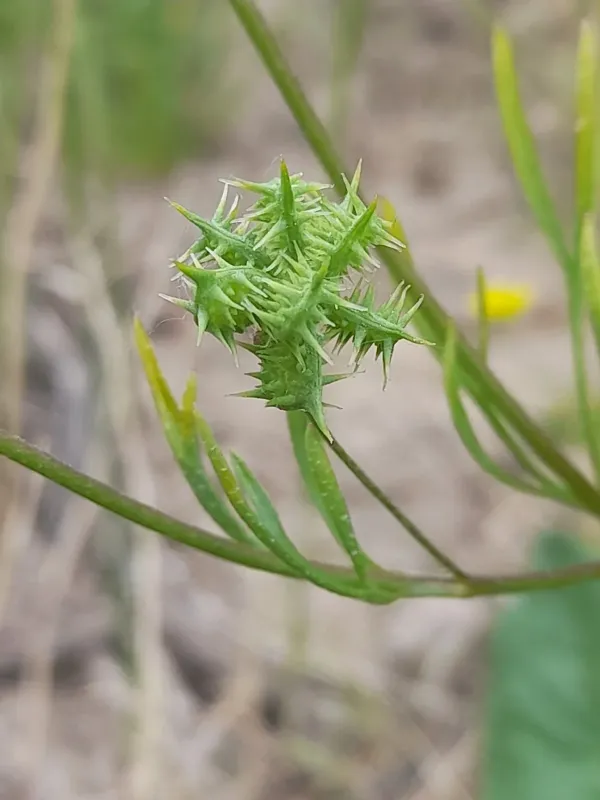
Small, pale yellow flowers bloom during the spring. A key identification trait is the fruit, which consists of achenes covered with sharp spines or tubercles.
Propagation is strictly through seeds, which exhibit long-term dormancy in the soil, allowing the seed bank to persist for several seasons.
Where it grows
This weed thrives in moist, heavy soils such as clays and loams. It is frequently associated with fields that have poor drainage or excessive soil moisture.
It is predominantly found in winter and spring cereal crops, particularly in wheat and barley fields, as well as in fallow land and along field margins.
Corn buttercup acts as a moisture-loving species; it often dominates in low-lying areas of the field where water pools after rainfall.
The plant's distribution is favored by mild climates with sufficient spring rainfall, which facilitates germination and early establishment.
It has become a notable problem in conservation tillage systems where surface soil moisture remains higher than in conventional plow-based systems.
Harm it causes
Corn buttercup is a strong competitor for nutrients and water, often significantly reducing the yield and quality of cereal grain harvests.
The plant contains protoanemonin, a toxic glycoside that can cause severe irritation or poisoning if ingested by livestock through contaminated forage or hay.
Heavy infestations interfere with harvesting operations, as the succulent green biomass can clog combine harvesters and increase grain moisture content.
By creating dense mats of vegetation, the weed can reduce air circulation within the crop canopy, indirectly favoring the development of various fungal pathogens.
Economic losses arise from both direct yield suppression and the necessity for additional cleaning and drying processes after harvest.
How to control
Effective management begins with cultural practices, such as proper crop rotation and the use of competitive crop varieties that shade out seedlings.
Deep tillage is highly recommended to bury seeds to a depth where they fail to germinate, significantly reducing the surface seed bank.
Chemical control involving selective herbicides is most effective when applied at the seedling or early rosette stage of the weed.
Maintaining clean field borders and managing drainage to eliminate standing water are critical steps to prevent the spread of this species.
- Use high-quality, weed-free certified seeds for planting.
- Monitor field edges and ditches to prevent seed migration.
- Employ timely harrowing or mechanical weeding in early crop stages.
Content graph
Connections · Corn buttercup
Most often together:
Marketplace
Products · 6


Biology
Taxonomy
- Latin name
- Ranunculus arvensis
- Family
- Лютик ползучий
- EPPO code
- RANAR