
Long-fruited thimbleweed
Anemone cylindrica
Description
How to tell it apart
Anemone cylindrica, commonly known as long-fruited thimbleweed, is a perennial herbaceous plant belonging to the Ranunculaceae family. It is recognized by its distinct upright growth habit and unique inflorescence structure.
The plant grows to a height of 30 to 60 centimeters, featuring palmately lobed leaves that are mostly clustered at the base. The stems are typically simple, sometimes branched near the top, and covered with fine hairs.
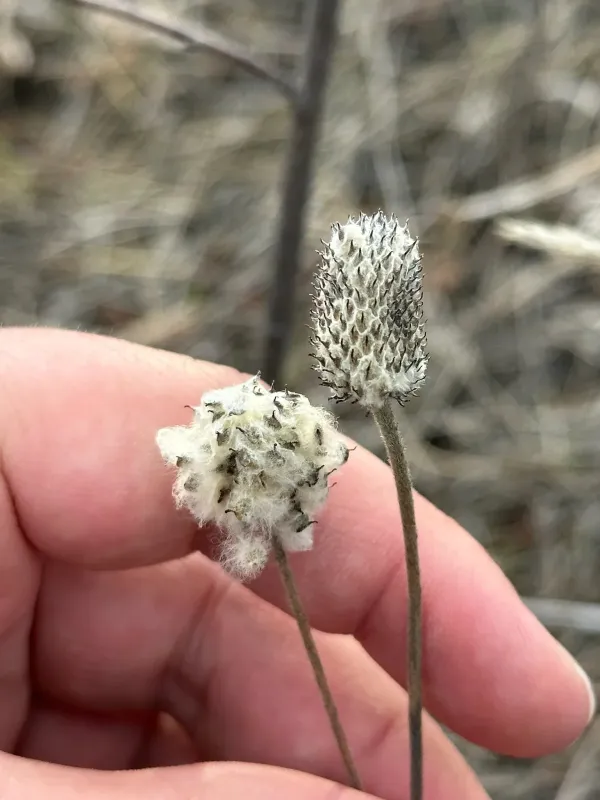
Its most characteristic feature is the fruiting head, which is elongated and cylindrical in shape, resembling a small thimble. This structure is what gives the plant its common name and distinguishes it from other Anemone species.
The flowers are small, greenish-white in color, and lack true petals, instead relying on conspicuous, petal-like sepals. Blooming typically occurs throughout the early to mid-summer period.
The seeds are achenes, each equipped with long, silky hairs that facilitate wind dispersal. This method of reproduction allows the weed to spread efficiently across open fields and degraded areas.
Where it grows
Long-fruited thimbleweed is primarily found in open habitats such as prairies, dry meadows, and forest openings. It thrives in well-drained soils and prefers sites with full sun exposure, where competition from other vegetation is moderate.
In agricultural settings, it frequently colonizes field edges, fence lines, and areas that are not subjected to regular cultivation. It is a common invader of degraded pastures and unmanaged buffer zones near farmland.
While not as aggressive as some invasive species, it can persist in perennial cropping systems. Its presence is often an indicator of soil disturbance or lack of intensive management in the specific area.
The plant is highly drought-tolerant, which allows it to persist in arid regions where other weeds might struggle. This resilience makes it a persistent inhabitant of dryland agricultural fields and associated habitats.
Colonization often starts in non-crop areas, from which it slowly spreads into the edges of productive fields. If left unchecked, the rhizomatous root system allows it to form dense, localized patches that are difficult to manage.
Harm it causes
The primary economic impact of Anemone cylindrica is its competition with crops for water and mineral nutrients. Its extensive root system allows it to effectively extract moisture from the soil, depriving nearby crops of resources.
Like many members of the Ranunculaceae family, the plant contains protoanemonin and other potentially toxic compounds. If ingested by livestock in hay or grazing, it may cause digestive irritation or systemic toxicity.
In perennial forage crops, thimbleweed can displace desirable species, reducing the overall yield and nutritional quality of the hay. This leads to long-term degradation of the pasture if the weed population is not controlled.
The plant can act as a secondary host for various insects and plant diseases, which may spread to neighboring commercial crops. This increases the complexity of integrated pest management on the farm.
The dense root structure interferes with mechanical operations such as tillage and mowing. The persistence of the plant means that repeated removal efforts are often required to reclaim the land from established patches.
How to control
Successful management of Anemone cylindrica requires a combination of mechanical and chemical strategies. Deep tillage is effective in disrupting the rhizomes and preventing the plant from re-establishing itself in the following season.
Preventive measures include managing field margins to ensure the plant does not set seed. Controlling the weed before it flowers is critical, as wind-dispersed seeds can infest previously clean areas of the farm.
Systemic herbicides, particularly those targeting perennial broadleaf weeds, are recommended for chemical control. These should be applied during the plant's active growth phase to ensure translocation into the root system.
Crop rotation and the use of competitive cover crops can help suppress the growth of the weed by limiting the light and nutrients available to it. Maintaining a healthy, dense canopy is key to preventing the establishment of light-demanding weeds.
- Deep mechanical tillage to destroy the root system.
- Application of systemic herbicides before flowering.
- Regular monitoring and mowing of field edges.
- Promoting vigorous crop growth to shade out weed seedlings.
Taxonomy
- Latin name
- Anemone cylindrica
- Family
- Лютиковые
- EPPO code
- ANMCY