
Early Meadow-rue
Thalictrum dioicum
Description
How to tell it apart
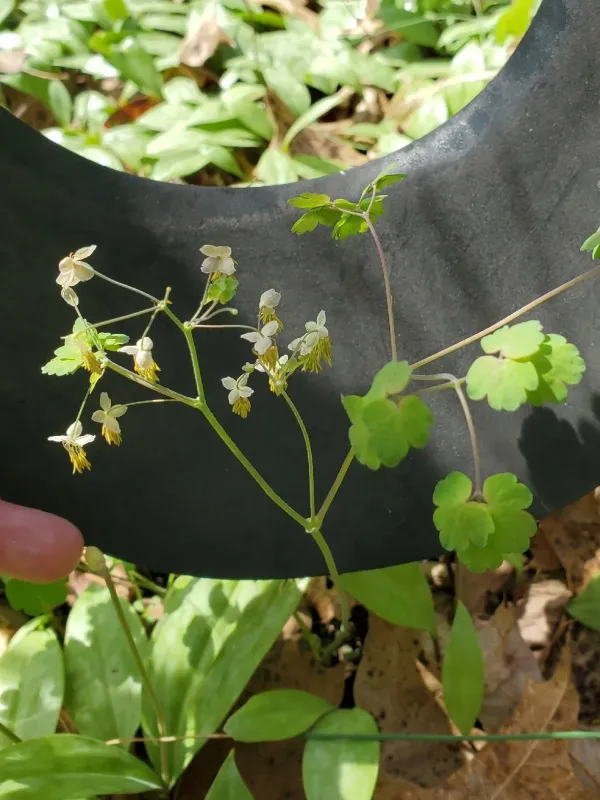
Early Meadow-rue (Thalictrum dioicum) is a perennial herb belonging to the Ranunculaceae family. It is characterized by compound, ternately decompound leaves that often exhibit a glaucous, blue-green appearance.
The plant features distinct, drooping male and female flowers on separate individuals, as it is a dioecious species. This reproductive strategy influences its population dynamics in wild and agricultural environments.
The stems are erect, branched above, and typically reach heights of 30 to 60 cm. Its growth habit allows it to form localized clusters, which can interfere with crop development if left unchecked.
It propagates via both seeds and an extensive root system. The seeds are small and lightweight, facilitating dispersal through environmental vectors like wind and running water.
Identification in the field is most successful during the early spring when the plant emerges before many other species, displaying its unique foliage against the bare soil of field edges.
Where it grows
This weed prefers moist, shaded habitats including woodlands, riverbanks, and low-lying, damp areas in fields. It is frequently found in areas with high soil moisture levels.
In agricultural systems, it colonizes the margins of fields, drainage ditches, and uncultivated buffers. From these areas, it can spread into the main crop field during periods of environmental disturbance.
It thrives in soils rich in organic matter but can tolerate various soil textures, provided that humidity levels remain consistent throughout the growing season.
The plant is commonly found in meadows and permanent pastures that are not frequently ploughed, allowing the perennial root system to establish and expand over time.
As a forest-edge species, it tends to colonize fields situated near wooded areas or thickets, taking advantage of the microclimatic conditions found at these interfaces.
Harm it causes
The primary harm caused by Early Meadow-rue is its competitive nature for nutrients and water, especially in early spring when crop demand is rapidly increasing.
Its robust root system acts as a resource sink, depriving neighboring crops of nitrogen and moisture, which leads to reduced biomass and yield suppression.
In forage production, the presence of Meadow-rue is undesirable because members of the Ranunculaceae family can contain toxins that affect livestock if consumed in large quantities.
Dense patches of this weed create physical obstruction for agricultural machinery, potentially leading to increased harvest losses and damaged equipment during field operations.
The weed acts as a host for various pathogens and pests that can transition to economically important crops, complicating integrated pest management strategies.
How to control
Cultural control is centered on deep tillage to physically disturb and expose the root system to desiccation. This is most effective when performed during dry weather conditions.
Effective crop rotation, especially incorporating competitive crops or frequent mechanical weeding, helps to exhaust the energy stored within the weed's underground structures.
Chemical control is most effective when systemic herbicides are applied during the plant's vegetative growth stage, ensuring the active ingredient reaches the roots.
- Application of non-selective herbicides like glyphosate for field border sanitation.
- Use of selective post-emergence herbicides compatible with the main crop to manage established patches.
- Timely mowing of non-crop areas to prevent seed set and further dispersal.
Integrated strategies are required to maintain long-term suppression, as individual control methods are rarely sufficient to eliminate established perennial colonies entirely.
Taxonomy
- Latin name
- Thalictrum dioicum
- Family
- Лютиковые
- EPPO code
- THCDO