

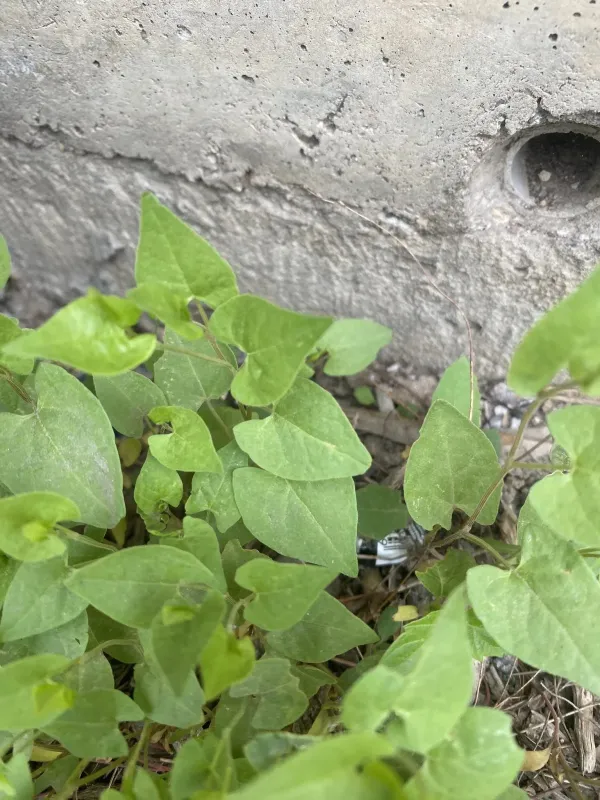
Description
How to tell it apart
Black-bindweed (Fallopia convolvulus) is an annual herbaceous plant belonging to the Polygonaceae family. It is a climbing weed with stems that can grow up to 100 cm in length, often twisting around crop stems or spreading across the soil surface.
The leaves are heart-shaped or arrowhead-shaped and set on long stalks. The leaf surface is slightly rough to the touch, which helps the plant cling to objects and climb effectively.
The root system is a taproot that reaches deep into the soil. This feature provides the plant with exceptional drought resistance and the ability to survive in various soil conditions.
The flowers are small, greenish-white, and clustered in loose spikes. Flowering occurs throughout the summer and into autumn, leading to the production of a vast amount of seeds.
The seeds are triangular, covered in a matte black husk. They can remain viable in the soil for up to a decade, posing a long-term challenge for farmers attempting to eradicate the weed.
Where it grows
Black-bindweed is a cosmopolitan plant found across temperate regions worldwide. It thrives in fertile, loose soils but adapts well to a wide range of environments, including field edges and gardens.
It frequently infests cereal crops such as wheat, barley, and oats, as well as row crops like corn, sunflowers, and sugar beets, where it can quickly become a dominant species.
It is commonly seen in areas with disturbed soil, along roadsides, and in waste ground. Its rapid growth allows it to claim territory where the natural vegetation has been cleared or damaged.
The plant has a preference for nitrogen-rich soils, making it a regular visitor to fields that receive heavy fertilization or plots near livestock waste storage areas.
In wet climates or during rainy seasons, black-bindweed can grow aggressively, forming dense mats that compete directly with crops for space, light, and essential soil nutrients.
Harm it causes
The primary damage caused by black-bindweed is crop lodging. By wrapping its stems around crop plants, it adds weight and structure that causes them to collapse, leading to significant harvest losses.
It acts as a strong competitor for moisture and nutrients. Because of its deep taproot, it extracts resources that the primary crop needs, leading to reduced overall plant vigor.
The dense foliage of black-bindweed shades the crop, significantly reducing the efficiency of photosynthesis. This process results in smaller grain size and lower total biomass accumulation.
The presence of bindweed seeds in the harvest lowers the commercial value of the grain. Farmers often face additional costs for seed cleaning, calibration, and drying to meet market standards.
Additionally, black-bindweed acts as a host for various pathogens and pests that affect cereal crops, increasing the disease pressure within the field during the growing season.
How to control
Agronomic control involves deep autumn plowing to bury seeds at depths that inhibit germination. Pre-sowing harrowing is also an effective method for destroying young seedlings before they establish.
For row crops, regular inter-row cultivation is essential. This mechanical disruption kills bindweed plants before they become too intertwined with the crop and harder to reach.
Crop rotation is a vital strategy. Changing the crop type each season disrupts the life cycle of black-bindweed, making it harder for the population to build up over time.
Chemical control usually involves the application of selective herbicides. For the best results, treatments should be applied while the weeds are in the early growth stage, before they develop too much leaf area.
- Use high-quality, weed-free planting seeds.
- Maintain clean field borders to prevent spread.
- Apply herbicides during the early vegetation phase for maximum efficacy.
Content graph
Connections · Black-bindweed
Most often together:
Marketplace
Products · 138


Galera 334 SL
Доу АгроСайенсіс С.А.С., Друзенхайм, Франція
Herbicides
0
0
·
2.6K
4 offers
14.3 €per 1 l
Buy

Gold Star
ТОВ «Фабрика агрохімікатів», Черкаси, Україна
Herbicides
0
3
·
2.4K
15 offers
28.75 €per 1 l
Buy

Trimer
Цзянсуський завод отрутохімікатів «Жуй Бан», Джітан , Китай.
Herbicides
0
0
·
1.6K
1 offer
85.35 €per pack
Buy


Mortira, WG herbicide Tribenuron-methyl
ZAT «August-Bel», Republic of Belarus
Herbicides
0
0
·
63
2 offers
27.89 €per 1 l
Buy


Granstar Pro 75
«Дюпон Інтернешнл Оперейшнз Сарл», Швейцарія
Herbicides
0
0
·
61
4 offers
3.47 €per pack
Buy


Hepi Star, WG (tribenuron-methyl, 750 g/kg)
ТОВ «Фабрика агрохімікатів», Черкаси, Україна
Herbicides
0
0
·
56
1 offer
25.1 €per 1 l
Buy


Herbicide PICA-DOR, V.R.K., (imazethapyr 100 g/l)
«Нанджин Ессенс Файн-Кемікал Ко. Лтд» (Китай)
Herbicides
0
0
·
55
1 offer
10.35 €per 1 l
Buy


Tanais, w.g., (Rimsulfuron, 250 g/kg)
Unicity Enterprises L.P.
Herbicides
0
0
·
54
4 offers
66.22 €per 1 l
Buy

Alpha-Brigadier c.e.
«Юнісіті Ентерпрайсіс Л.П.», Единбург, Великобританія
Herbicides
0
0
·
54
2 offers
44.02 €per pack
Buy

TRU, WG, (Tribenuron-methyl, 750 g/kg)
Sharda Worldwide Exports Pvt Ltd, Sharda World
Herbicides
0
0
·
54
4 offers
74.7 €per 1 l
Buy

Caméo 75 WG (Sameo 75 WG)
Cheminova Agro France S.A.S.
Herbicides
0
0
·
53
2 offers
1 454.57 €per pack
Buy


Prime
Hailir Pesticides and Chemicals Group Co., Ltd, Shandong, КНР
Herbicides
0
0
·
51
2 offers
5.49 €per 1 l
Buy


SAMSON Extra 6 OD
«Аріста ЛайфСайенс С.А.С.» , Франція
Herbicides
0
0
·
50
2 offers
23.15 €per 1 l
Buy


Agrostar
ТОВ «Фабрика агрохімікатів», Черкаси, Україна
Herbicides
0
0
·
48
7 offers
6.67 €per 1 l
Buy



Galera Super
Доу АгроСайенсіс С.А.С., Друзенхайм, Франція
Herbicides
0
0
·
42
1 offer
66.65 €per 1 l
Buy

Sumaro, KS (mesotrione, 480 g/L)
Hangzhou Ruijiang Chemical Co., Ltd.
Herbicides
0
0
·
41
3 offers
19.35 €per 1 l
Buy

Biology
Taxonomy
- Latin name
- Fallopia convolvulus
- Family
- Однолетние двудольные сорняки