
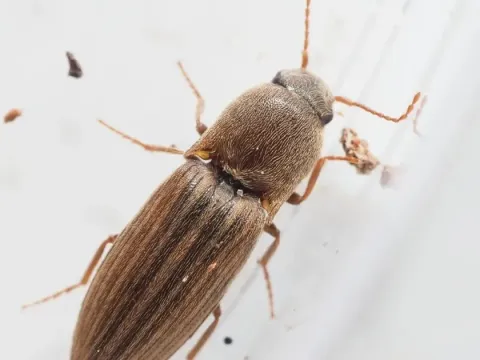
Conoderus rufangulus
Conoderus rufangulus
Conoderus rufangulus belongs to the Elateridae family, commonly known as click beetles, within the order Coleoptera. Adult beetles are characterized by a unique mechanism allowing them to snap and flip themselves over when placed on their backs.
What the section contains
Conoderus rufangulus
The adult body is elongated, usually colored in shades of dark brown or black with distinct reddish-orange corners on the pronotum. This specific coloration is a key identifier for this particular species.
The larvae, widely referred to as wireworms, possess a tough, cylindrical, and well-sclerotized body, typically yellow-brown in color. They are highly adapted to life beneath the soil surface.
The life cycle of these beetles is complex and spans several years, with the majority of development occurring in the soil profile. Adults are generally nocturnal, making them difficult to spot during daytime field scouting.
Precise identification usually involves laboratory analysis of the larval mouthparts and pronotal structures. However, field agronomists rely on observing the typical damage patterns and larval presence in the soil.
The larvae of Conoderus rufangulus are polyphagous pests that cause significant damage to a wide range of agricultural crops. They target the root systems and subterranean stems of many economically important plants.
Primary hosts include cereal grains, corn, sunflower, sugar beet, and potatoes. Wireworms can devastate young seedlings by chewing through the stems at the soil line, leading to rapid wilting and death.
Root damage inhibits nutrient and water uptake, resulting in stunted growth and uneven crop stands. The resulting loss in plant density significantly reduces the final yield potential of the field.
The feeding activity of wireworms creates wounds that serve as infection sites for secondary soil-borne pathogens, such as fungi and bacteria, which can cause severe rot diseases.
High larval populations can make entire fields unproductive, often necessitating replanting efforts or intensive soil treatment protocols during the next planting season.
The development of Conoderus rufangulus lasts several years, necessitating consistent monitoring throughout the crop rotation cycle. Both adults and larvae can overwinter in deeper soil layers.
As soil temperatures rise in the spring to 10-12 degrees Celsius, larvae migrate to the upper soil horizons. This coincides with the planting season, making germinating seeds and young seedlings particularly vulnerable.
Adult flight occurs from late spring through early summer. During this time, mating takes place, and females lay eggs in moist soil, often preferring areas with abundant organic matter.
During the heat of summer, when the topsoil dries out, larvae descend to deeper, more humid soil layers, temporarily reducing the pressure on the upper root zone.
With the onset of autumn rain and cooler temperatures, larvae may resume activity in the upper soil layers to feed before entering winter diapause.
The primary sign of an infestation is the sudden wilting and death of scattered plants across the field. Digging at the base of affected plants usually reveals larvae or signs of tunneling in the roots.
In root crops such as potatoes and beets, presence is confirmed by narrow, deep tunnels drilled into the tubers or roots, which severely degrade market quality and storage potential.
In cereal fields, irregular patches of missing or stunted plants indicate concentrated larval feeding. These "gaps" in the field are classic indicators of wireworm presence.
Soil sampling in the root zone is the most effective way to detect larvae. Because they are hardy and quick-moving, they are easily visible once unearthed from the soil.
The presence of certain grasses like couch grass (Elymus repens) often correlates with higher wireworm numbers, as these weeds provide a stable food source and favorable micro-environment.
Effective management requires an integrated pest management (IPM) approach that combines cultural, chemical, and biological strategies.
- Crop rotation: Avoiding susceptible crops and utilizing non-host cover crops can disrupt the lifecycle.
- Tillage: Deep plowing exposes larvae to surface predators like birds and desiccating environmental conditions.
- Soil pH management: Applying lime to reduce soil acidity can make the environment less hospitable for larvae.
- Seed treatment: Using systemic insecticidal seed treatments is highly effective in protecting plants during the critical germination phase.
- Soil insecticides: Applying granulated insecticides at the time of planting provides a protective barrier in the seed furrow.