
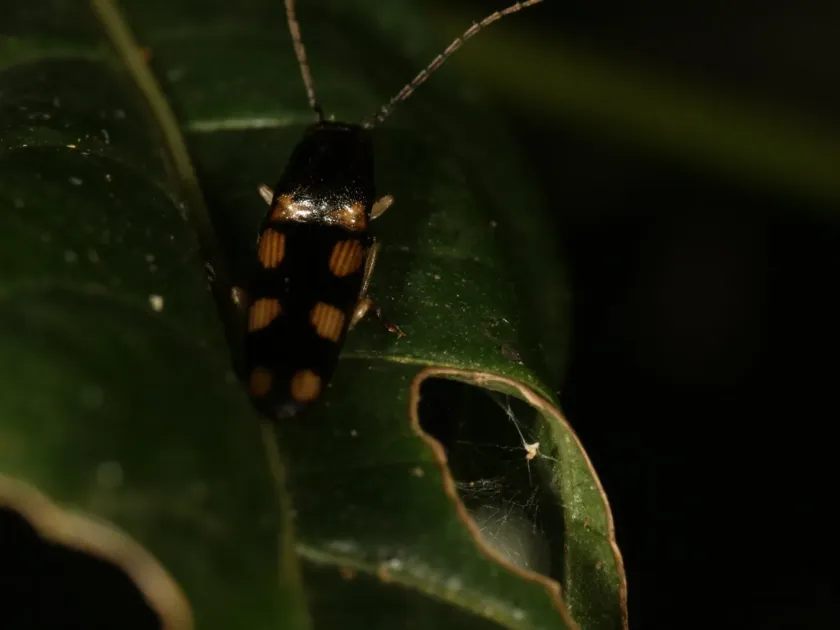
Click beetle of the genus Aeolus
Aeolus
Description
How to identify
The genus Aeolus belongs to the family Elateridae, commonly known as click beetles. These insects are characterized by their ability to "click" and flip themselves upright if they land on their backs.
Adult beetles typically have elongated bodies measuring between 5 and 12 mm in length. Their coloration is usually brownish to reddish, often featuring a mottled pattern on their elytra that serves as effective camouflage in soil.
Their larvae, widely known as wireworms, are recognizable by their hard, cylindrical, and yellow-to-brown bodies. They are highly mobile within the soil profile and possess strong mandibles for feeding on roots and tubers.
The life cycle involves a complete metamorphosis through four stages: egg, larva, pupa, and adult. Development is slow, often spanning several years depending on soil temperature and moisture conditions.
This pest prefers well-drained, warm soils and is often found in agricultural fields where larvae can easily navigate through the root zone in search of food sources.
What it damages
Aeolus larvae are dangerous polyphagous pests that cause significant damage to a wide range of crops, including cereals, vegetables, and tubers.
The most severe damage occurs during the germination and early seedling stages, as wireworms feed on seeds and bore into the base of young stems, often causing plant death and stand thinning.
By damaging the root systems, larvae create entry points for secondary soil-borne pathogens, leading to root rots and reduced nutrient uptake, which ultimately stunts plant growth.
For tuber crops, wireworms create deep feeding tunnels, which significantly reduce the marketability of the produce and make it susceptible to storage rots.
Heavy infestations can lead to substantial yield losses, sometimes necessitating total field replanting if the population density of the larvae is high during the critical establishment phase.
When it appears
Adult Aeolus beetles typically emerge in late spring and are active throughout the summer, feeding on nectar and pollen from various flowering plants.
After mating, females lay eggs in the top layer of the soil, especially in areas with moderate moisture, which ensures the survival of the neonate larvae upon hatching.
Larval activity in the upper soil profile is highest during the spring, coinciding with the optimal temperature range of 10-15°C, which is also the time when crops are most vulnerable.
During the hot and dry summer months, larvae migrate deeper into the soil to escape desiccation, moving back toward the surface as temperatures cool in the autumn.
Overwintering occurs at depths of 30-50 cm, where larvae, pupae, and sometimes adults remain until the soil warms up in the following spring.
Signs of infestation
The primary symptom of an Aeolus infestation is the appearance of uneven or thin crop stands, with some seedlings failing to emerge or appearing stunted and chlorotic.
If affected plants are excavated, the roots will often show evidence of feeding, such as ragged edges, severed taproots, or internal tunneling, often with a wireworm found nearby.
Visible holes or galleries in potatoes, carrots, and other root vegetables are definitive signs of larval feeding activity during the growing season.
Sudden wilting of individual plants in a row, even when soil moisture is adequate, indicates that the vascular system has been compromised by wireworm feeding at the base of the stem.
Seeing adult click beetles on weeds or nearby foliage in late spring can serve as an early warning for potential infestation, as it signals the start of the egg-laying period.
Control measures
Crop rotation is the foundation of management; rotating away from susceptible crops disrupts the multi-year life cycle of the wireworm and reduces population pressure.
Effective weed management, particularly the removal of perennial grasses like quackgrass, is crucial, as these weeds provide essential alternative food sources for larvae.
Deep autumn tillage with soil inversion helps expose larvae and pupae to predators and adverse weather, significantly reducing their numbers before the next growing season.
Seed treatments with systemic insecticides are currently the most effective method for protecting seeds and seedlings from early-season wireworm damage.
- Using trap crops like oats or corn to divert larvae away from the main crop.
- Applying granular soil insecticides during planting for localized protection.
- Employing biological control agents, such as entomopathogenic fungi, in integrated pest management programs.
Taxonomy
- Latin name
- Aeolus
- Order
- Coleoptera (beetles)
- Family
- Elateridae
- EPPO code
- AEOLSP
Discussion
No discussions yet — be the first.