
Conoderus amplicollis
Conoderus amplicollis
Description
How to identify
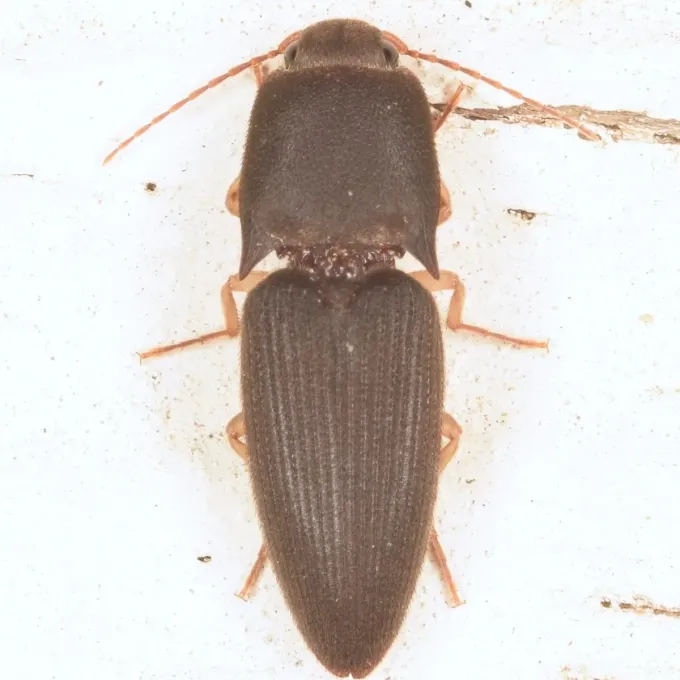
Conoderus amplicollis, commonly known as a type of wireworm, belongs to the family Elateridae (click beetles) within the order Coleoptera. Adult beetles are typically 10–12 mm long, exhibiting an elongated body shape with a distinct brownish-to-black coloration and dense, fine hairs. A key diagnostic feature is the widened pronotum, which is broader than in many other local click beetle species.
The larvae, known as wireworms, are the primary life stage of concern. They possess a hard, cylindrical, and smooth body, which can grow up to 20–25 mm in length. Their coloration ranges from yellow to dark reddish-brown, and their integument is highly sclerotized, providing resistance against soil pressure and mild environmental stressors.
The biology of Conoderus amplicollis is strictly tied to the soil environment, where the insects spend most of their life cycle. Adults are generally nocturnal or crepuscular, often hiding under debris or in dense vegetation during the day. Their ability to fly allows for the colonization of new fields, making them mobile pests.
The life cycle involves complete metamorphosis, consisting of the egg, larval (with several instars), pupal, and adult stages. Depending on soil moisture and temperature, the development process can take one to two years to complete. Larvae are highly resilient and capable of vertical migration in the soil profile depending on seasonal changes.
Reproduction occurs in the soil, where females deposit eggs in clusters. Larvae thrive in soils with moderate organic matter content and sufficient moisture. Before causing agricultural damage, young larvae often feed on organic debris and smaller roots, gradually increasing their consumption rates as they mature into larger instars.
##damage##The damage is caused by the larvae, which are voracious soil dwellers. They feed on the seeds, roots, and subterranean stems of various plants. In crops like corn, they often destroy the developing seed or feed on the primary roots, causing the seedlings to wither and die, which results in significant stand reduction.
Crops susceptible to Conoderus amplicollis include maize (corn), potatoes, tobacco, and various solanaceous vegetable crops. The damage is most severe during the early vegetative stages, when the plant's root system is not robust enough to recover from the feeding injury caused by the wireworms.
Direct consumption of root tissues is not the only harm; the feeding wounds act as entry points for various soil-borne pathogens, including fungi and bacteria. These pathogens cause rot in the root and stem bases, leading to total plant collapse even if the initial wireworm damage was not severe enough to kill the plant.
In potato cultivation, wireworms burrow deep, narrow tunnels into the tubers. This mechanical damage renders the potatoes unmarketable and significantly reduces their storage life. In heavily infested soils, the damage can be widespread, making the entire harvest unsuitable for commercial use.
Economic losses are often compounded by the patchy distribution of the pest. Since wireworms can persist in the soil for multiple years, a single infestation can cause recurring damage across several planting cycles if effective soil management practices are not implemented.
##season##The seasonal activity of Conoderus amplicollis is driven by soil temperature and moisture levels. In early spring, once the soil warms up to approximately 10–12 degrees Celsius, the larvae migrate from deeper layers toward the surface to begin active feeding on germinating seeds and young root systems.
The peak of larval damage coincides with the seedling stage of most annual crops. During this time, the larvae are most energetic following winter diapause and require high nutrient intake to continue their development, leading to rapid destruction of crop stands if populations are dense.
Adult beetles appear on the surface from late spring through mid-summer. This period involves mating and egg-laying. Adults are attracted to fields with high soil moisture and cover, such as those with grassy weeds or minimal tillage, which provide optimal microclimates for their survival.
As autumn temperatures drop, the larvae begin their downward migration into deeper soil horizons (usually 20–40 cm or more) to escape the cold. This hibernation behavior allows them to survive even harsh winter conditions, ensuring a stable population density for the following season.
Environmental conditions, such as prolonged drought, may suppress larval activity in the upper soil layers temporarily, but they generally return to the root zone once moisture becomes available. Thus, the pest remains a constant threat throughout the growing season.
##signs##One of the earliest signs of an infestation is the sudden wilting of scattered plants despite adequate soil moisture. When the soil around the base of these wilting plants is excavated, larvae are often found feeding on the root system or near the seed remnant.
Confirmation of the pest's presence can be achieved using bait traps. Commonly, potato slices or soaked cereal grains are buried at a depth of 5–10 cm in the field. After several days, these traps are retrieved and examined to count the number of larvae attracted to the food source.
In potatoes, evidence of infestation includes the presence of clean-cut entry holes on the tubers upon harvest. Even if the wireworms have moved deeper, these characteristic tunnels are unmistakable indicators of their previous feeding activity within the crop.
Corn fields may exhibit missing plants or stunted growth in specific areas. If a plant is easily pulled from the ground, it usually indicates that the roots have been severed or extensively damaged by wireworm feeding, leaving the plant unsupported.
- Patchy or thin stands in fields shortly after emergence.
- Plants exhibiting wilting or yellowing without obvious foliar disease.
- Tunnels and boreholes discovered in harvested root vegetables or tubers.
- Increased presence of adult click beetles in light traps or sticky cards during the evening.
- Significant damage to the primary root structures of young transplants.
Cultural management is the cornerstone of controlling Conoderus amplicollis. Crop rotation is essential; avoiding the planting of highly susceptible crops immediately after grassy pastures or sod can prevent the rapid build-up of wireworm populations that thrive in undisturbed, grass-heavy environments.
Deep tillage or mechanical cultivation in late summer or autumn is highly effective. This practice exposes the larvae and pupae to desiccation by the sun and makes them easily accessible to avian predators like birds, which significantly reduces the population before the next planting season.
Weed management, especially the control of perennial grasses like couch grass (Elymus repens), is crucial. These weeds provide the necessary food and shelter for wireworms to survive and multiply, making a weed-free field significantly less attractive to egg-laying adults.
Chemical control often involves the use of insecticidal seed treatments or the application of granular soil insecticides during planting. These methods provide a critical zone of protection around the seed and seedling roots during the most susceptible early growth stage.
Biological control using entomopathogenic fungi, such as Metarhizium anisopliae or Beauveria bassiana, is gaining popularity. When incorporated into the soil, these fungi naturally infect and kill wireworms, providing a sustainable management option that reduces long-term population pressure without relying solely on synthetic chemicals.
Taxonomy
- Latin name
- Conoderus amplicollis
- Order
- Coleoptera (beetles)
- Family
- Elateridae
- EPPO code
- CONOAM
Discussion
No discussions yet — be the first.