
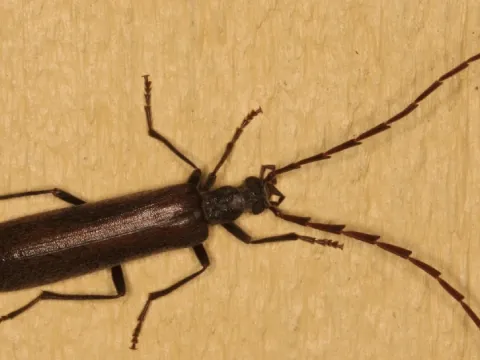
Calopus serraticornis
Calopus serraticornis
Calopus serraticornis is a beetle belonging to the Oedemeridae family, often referred to as false blister beetles. Adult specimens typically measure between 12 and 20 mm in length, possessing an elongated, slightly flattened body structure.
What the section contains
Calopus serraticornis
The name "serraticornis" is derived from the distinctive serrated antennae found on the beetles. Their bodies are covered in fine pubescence, giving them a matte appearance, while the elytra feature faint longitudinal ridges.
The larvae are whitish, legless, and possess powerful mandibles designed for excavating tunnels through wood. They live deep within the timber, remaining hidden for most of their developmental stage.
Taxonomically, they are classified under the order Coleoptera. These insects are primarily associated with coniferous trees, playing a specific role in the natural decomposition of dead wood in forest ecosystems.
Despite their size, these beetles are primarily nocturnal, which explains why they are rarely observed during daylight hours, even in areas with active infestations.
Calopus serraticornis larvae target coniferous wood, particularly spruce, fir, and pine. They prefer damp or decaying timber, making them a significant pest in wood storage yards and construction sites.
The economic impact occurs when larvae tunnel through structural timber, significantly compromising the integrity and load-bearing capacity of the wood material.
Unprotected wooden railway sleepers, utility poles, and construction lumber are particularly susceptible if left in direct contact with the ground or exposed to high humidity.
Because the larvae reside deep inside the wood, internal structural failure can occur long before any external signs are visible to the property owner or warehouse manager.
In forest management, they are considered secondary pests, as they usually attack trees that have already been weakened by other factors or are already dead.
The flight period for adult beetles generally occurs from late spring through mid-summer, typically between May and August, when they emerge to mate and lay eggs.
The lifecycle is prolonged, with the larval stage lasting one to two years depending on the environmental conditions and the quality of the wood substrate.
Pupation usually takes place in the spring, within a specially constructed chamber near the surface of the wood, preparing the insect for its emergence as an adult.
The rate of development is heavily influenced by the humidity level of the wood; moisture is essential for the larvae's survival and growth inside the timber galleries.
Once the adult beetle emerges, it leaves a characteristic exit hole, signaling the completion of its life cycle and the potential for a new generation to begin.
The most reliable sign of an infestation is the presence of oval-shaped exit holes on the surface of the timber, created by adults leaving the wood.
Accumulations of frass, which consists of fine wood dust and excrement, can often be found beneath infested logs or near the base of wooden structures.
Tapping the wood produces a hollow sound, indicating that the internal structure has been compromised by a network of larval galleries.
Upon cutting into infested material, one can clearly see the intricate, winding tunnels filled with sawdust, which confirms the presence of wood-boring larvae.
Visual identification of adult beetles around artificial lights at night serves as a warning that a breeding population may exist in the immediate vicinity.
Preventive measures are the most effective strategy, focusing on keeping wood off the ground using pallets to prevent the moisture absorption that attracts the beetles.
Sanitation of forest areas, including the prompt removal of stumps and fallen deadwood, helps reduce the overall population pressure in the area.
Chemical control involving deep-penetrating insecticides is recommended for timber that has already been placed in structures and is at risk of infestation.
- Kiln-drying timber to reduce moisture content below 15%.
- Applying insecticidal wood preservatives during the construction phase.
- Using physical barriers like paints or varnishes to deter egg-laying.
In cases of severe warehouse infestation, professional fumigation of the stored timber products is necessary to eradicate all larval stages effectively.