
Conoderus auritus
Conoderus auritus
Description
How to identify
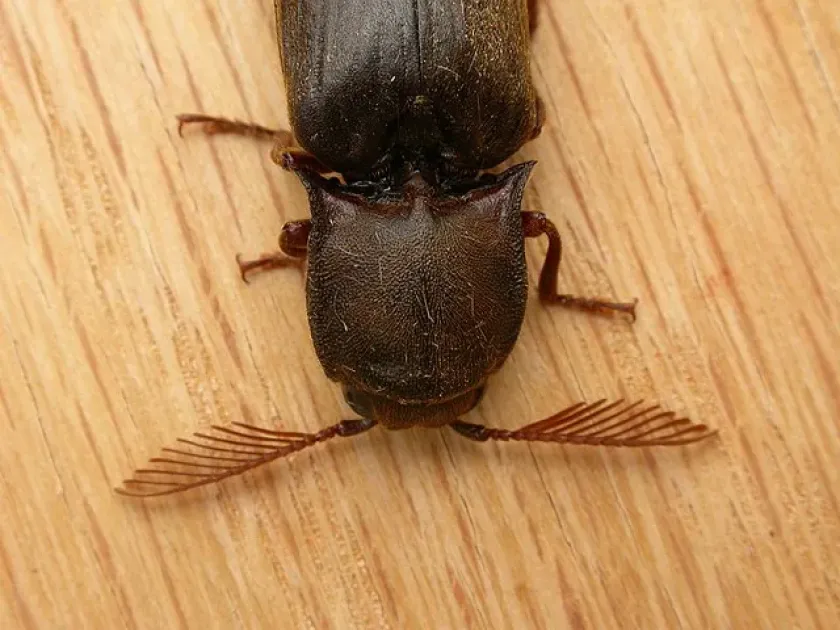
Conoderus auritus, commonly known as a click beetle, belongs to the Elateridae family, order Coleoptera. Adult beetles are typically 8–10 mm in length with an elongated, oval body shape.
The coloration of these beetles ranges from dark brown to reddish-brown. They are easily distinguished by the distinct pointed projections on the pronotum, which resemble small ears.
The larvae, known as wireworms, have a hard, chitinous exoskeleton. They possess a cylindrical body that is yellow or brownish in color, equipped with three pairs of short thoracic legs.
The larval head features powerful biting mouthparts. The last abdominal segment has a unique structure that allows entomologists to identify the species within the Conoderus genus.
Adult beetles are famous for their ability to perform a snapping motion, accompanied by an audible click, allowing them to right themselves when placed on their backs.
What it damages
The primary damage is caused by the wireworm larvae living in the soil. They attack the root systems, subterranean stems, and seeds of various agricultural crops.
Major host crops include corn, sorghum, soybeans, cotton, and various cereals. Wireworms can destroy seeds before germination or kill young seedlings entirely.
Adults also feed on plant tissues, but their economic impact is significantly lower compared to the soil-dwelling larval stage. Their damage is usually considered minor.
High infestations often lead to reduced plant stands, which may force growers to replant fields, resulting in significant yield losses and increased production costs.
Feeding wounds created by wireworms often serve as entry points for soil-borne pathogens, leading to secondary issues like root rot and bacterial infections.
When it appears
The life cycle of Conoderus auritus spans several years, making population management challenging. Adult beetles emerge in spring when soil temperatures reach 10–12°C.
Oviposition typically occurs in late spring or early summer. Females prefer moist soil environments, often selecting areas with organic matter or weed cover for egg-laying.
Larvae develop in the soil over multiple seasons, displaying high resilience to environmental fluctuations. They can survive varying soil moisture levels throughout their development.
Larval activity is highest in the upper soil profile during spring and autumn when soil moisture and temperature are optimal for feeding on root systems.
During winter, the insects retreat into deeper soil layers, often 30–50 cm underground, to avoid freezing temperatures and ensure survival until the following season.
Signs of infestation
The first indicator of an infestation is the sudden wilting of young plants. Excavating the soil around affected plants usually reveals larvae or signs of larval feeding.
Seeds excavated from the soil often show characteristic boreholes. Over time, affected patches in the field become apparent as stunted or dead plants increase in number.
- Wilting of seedling tops despite adequate moisture.
- Presence of larvae or tunnels in underground stems.
- Reduced plant population density in specific field areas.
Wireworms prefer moist environments, so infestation symptoms are often more severe in low-lying areas or poorly drained sections of the agricultural field.
Monitoring adult beetle activity using light traps in the spring can provide an early warning sign of potential wireworm pressure for future planting cycles.
Control measures
Successful management of Conoderus auritus requires an integrated approach, utilizing cultural, chemical, and biological control strategies.
Crop rotation is a fundamental practice. Rotating away from highly susceptible crops like corn can effectively reduce the wireworm population density in the soil.
Using insecticidal seed treatments is currently the most effective method for protecting vulnerable seedlings during the critical early stages of crop development.
Cultural methods, such as deep autumn plowing, can help bring larvae to the surface, exposing them to predators, desiccation, and freezing temperatures.
Strict weed control throughout the season reduces the suitability of the field for egg-laying and eliminates alternative food sources for the developing larvae.
Taxonomy
- Latin name
- Conoderus auritus
- Order
- Coleoptera (beetles)
- Family
- Elateridae
- EPPO code
- CONOAU
Discussion
No discussions yet — be the first.