
Copper click beetle
Ctenicera cuprea
Description
How to identify
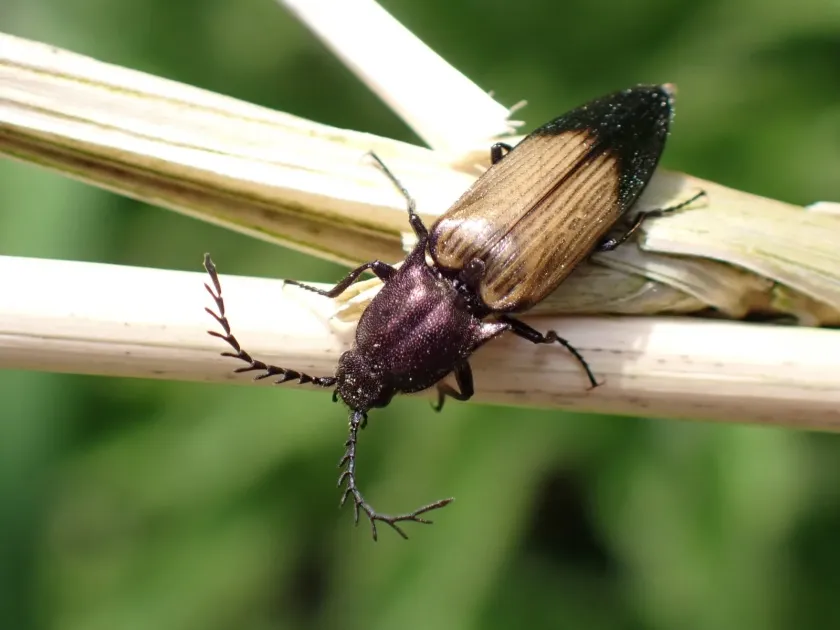
The Copper click beetle (Ctenicera cuprea) belongs to the family Elateridae (click beetles) within the order Coleoptera. Adult beetles are recognizable by their distinct copper-bronze coloration with a metallic luster.
The adult body is elongated, typically measuring 12 to 16 mm in length. The head and pronotum are often darker and densely covered with fine hairs, giving the beetle a somewhat matte appearance.
The family gets its name from a unique mechanism on the underside of the thorax, which allows the beetle to snap and jump when turned onto its back to regain its footing.
The larvae, commonly known as wireworms, are the primary damaging stage. They possess a cylindrical, heavily sclerotized body that is yellow or brownish, resembling a piece of stiff wire.
The life cycle involves complete metamorphosis (egg, larva, pupa, adult), with the larval stage living in the soil for several years before reaching maturity.
What it damages
Wireworms of Ctenicera cuprea are polyphagous soil-dwelling pests that feed on the seeds, roots, and underground stems of a wide range of agricultural crops.
Cereal crops like wheat, barley, and oats are highly susceptible. Larvae consume sown seeds, often leading to poor germination and significantly reduced stand density.
Vegetable crops, particularly potatoes, carrots, and sugar beets, suffer from larvae boring tunnels into the tubers and roots, rendering them unmarketable and prone to decay.
Corn and sunflower crops are also frequently attacked, with larvae causing significant damage to the roots, which stunts plant growth and can cause entire plants to collapse.
Damage caused by these pests facilitates the entry of soil-borne pathogens, leading to secondary rot and further weakening the root systems of affected plants.
When it appears
Adult beetles typically emerge in the spring, from May to June, and are active throughout the early summer months when mating and egg-laying occur.
Females deposit their eggs in moist soil, often preferring areas with dense vegetation or high organic matter content, which ensures optimal conditions for hatching.
The larvae reside in the soil for several years and are known for their vertical migrations based on seasonal changes in moisture and temperature.
During the spring and autumn, when the upper soil layers are moist and temperate, larvae are concentrated in the top 10–15 cm of soil, where they actively feed.
In hot, dry summer months or during severe winter freezing, larvae retreat to deeper soil horizons to protect themselves from extreme environmental conditions.
Signs of infestation
The most noticeable sign of a wireworm infestation is a patchy emergence of crops, with groups of plants appearing withered or yellowing without obvious surface causes.
An inspection of the root system often reveals cleanly eaten roots or boring holes in the base of the stems, confirming that the damage is subterranean.
During soil excavation in affected areas, the presence of hard, yellow-brown, worm-like larvae confirms the identity of the pest responsible for the plant loss.
For root crops, external signs include irregular holes on the skin, while deeper inspection reveals internal channels that have been bored out by the larvae.
- Patchy crop stands and stunted plant growth.
- Sudden wilting of seedlings in spring.
- Clear boring damage on root crops and tubers upon harvest.
Control measures
Integrated pest management is crucial for controlling this beetle. Deep autumn plowing is effective as it exposes larvae to predators and harsh weather conditions.
Crop rotation remains one of the most reliable cultural methods, particularly alternating susceptible crops with those that are less attractive to the larvae.
Seed treatment with systemic insecticides is a standard practice for protecting grains and corn during the vulnerable germination and early establishment phases.
Soil management practices, such as liming acidic soils or improving drainage, can create conditions that are less hospitable for larval survival and development.
In cases of high pest pressure, the application of soil-incorporated granular insecticides at the time of planting is recommended to prevent immediate damage.
Taxonomy
- Latin name
- Ctenicera cuprea
- Order
- Coleoptera (beetles)
- Family
- Elateridae
- EPPO code
- CORMCU
Discussion
No discussions yet — be the first.