
Agave scale
Acutaspis agavis
Description
How to identify
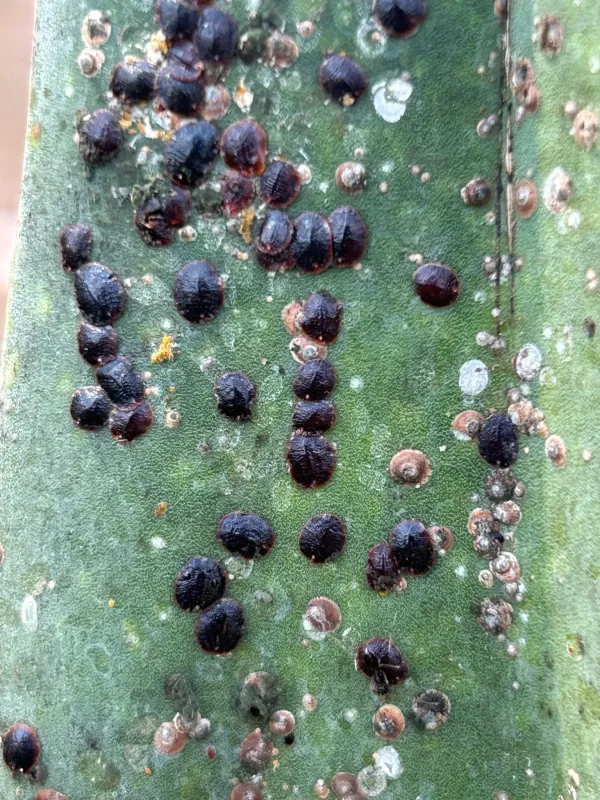
Agave scale (Acutaspis agavis) is a member of the Diaspididae family within the Hemiptera order. These are small sap-sucking insects that protect themselves beneath a hard, wax-like shield throughout their adult lives.
The adult females are sessile, meaning they remain stationary once they have secured a feeding site on the plant. The protective shield is typically brown to dark brown, camouflaging perfectly with the thick leaves of succulents.
The life cycle involves an egg stage, the mobile crawler stage (first instar), nymph stages, and the adult stage. The crawlers are the only active phase capable of moving between leaves or plants.
Adult males are much smaller than females, possess wings, and are rarely seen due to their short lifespan. They exist solely for reproduction and do not feed on the plant tissues.
The reproductive capacity of this pest is high, allowing it to colonize host plants rapidly if environmental conditions in a greenhouse or garden remain stable and warm.
What it damages
Agave scale primarily targets species within the Agavaceae family, such as various Agave and Aloe species. The pest uses its piercing-sucking mouthparts to extract vital nutrients directly from the plant cells.
Heavy infestations lead to significant nutrient loss, causing the plant to weaken progressively. This stress makes the host susceptible to secondary infections, such as bacterial or fungal rot.
Chlorotic spotting is a common symptom where the scale insects are feeding. These spots often turn into sunken necrotic areas as the plant tissue dies beneath the pressure of the shield.
Growth reduction is typical in infested plants. Young leaves may become stunted or deformed as the scale insects congregate near the growing tips or leaf bases.
If left unmanaged, extreme populations of Acutaspis agavis can cover the entire surface area of leaves, resulting in complete dehydration and eventual death of the succulent.
Signs of infestation
The most reliable sign of infection is the presence of small, firm, raised bumps on the foliage. These bumps are the waxy shields and can be scraped off with a thumbnail or a blunt tool.
Look for yellowish or light-colored discolored spots on the leaves. These patterns often indicate where the scale insects have been feeding for an extended period.
Stunted growth or leaves that lose their healthy, turgid appearance may suggest an infestation deep within the leaf folds or crevices where scales are hidden.
While scale insects rarely produce the heavy honeydew associated with other pests, some sticky residue may be present on leaves directly beneath a high-density colony.
During the warmer season, inspect the plant for tiny, pale crawlers. These appear as microscopic mobile dots moving slowly across the leaf surface toward new feeding sites.
Control measures
Physical removal is an effective first line of defense for small infestations. Using a soft-bristled brush or cotton swab dipped in isopropyl alcohol can dislodge the insects and dissolve their protective shields.
Systemic insecticides are generally required for severe or widespread infestations. These products are absorbed by the plant and poison the pests as they feed, providing more thorough coverage.
Application of horticultural oils or insecticidal soaps can be effective against crawlers, but these treatments often need repeated applications to catch successive generations of the pest.
Always maintain a strict quarantine for new plants. Keep them isolated for at least three weeks to monitor for any signs of scale before integrating them into your main succulent collection.
- Proper hydration and light levels help maintain the plant's natural defense.
- Use systemic treatments during the active growing season.
- Prune and destroy heavily infested leaf parts to prevent further spread.
Taxonomy
- Latin name
- Acutaspis agavis
- Order
- Hemiptera (bugs, aphids, leafhoppers)
- Family
- Diaspididae
- EPPO code
- CHRYAG
Discussion
No discussions yet — be the first.