

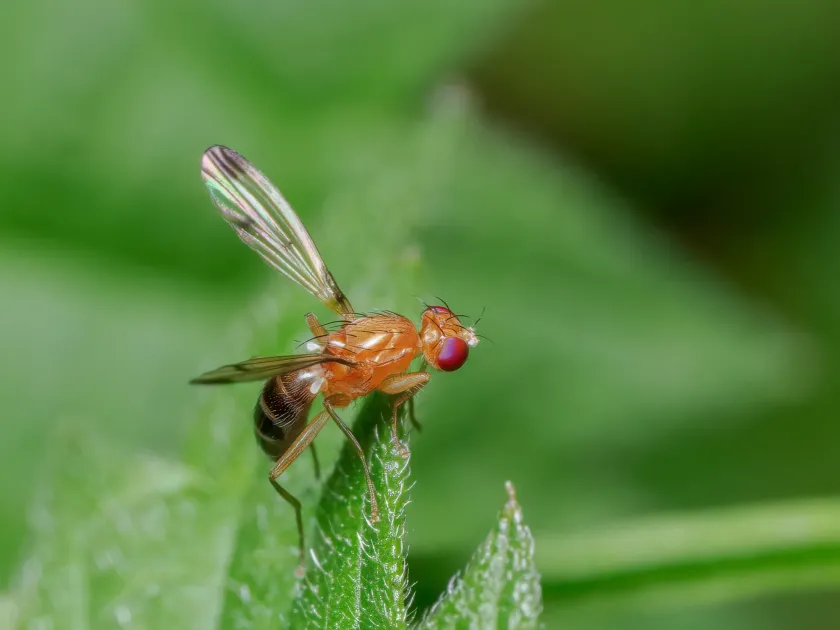
Description
How to identify
The yellow cereal fly (Geomyza combinata) is a small insect belonging to the family Opomyzidae, order Diptera. Adults are approximately 3–4 mm long, with a yellowish-brown body and distinct dark spots on their wings, which is a diagnostic feature of this species.
The larvae are legless, cylindrical, and reach about 5 mm in length. They are typically white or pale yellow and have a pointed head, which facilitates their movement into the stems of host plants.
The life cycle involves complete metamorphosis, including egg, three larval stages, pupa, and adult. Depending on the climatic region, this pest can complete one or two generations per year.
Overwintering typically occurs in the egg stage, which females deposit in the soil or at the base of winter cereal stems during the autumn. Larvae emerge in the spring to begin feeding on young shoots.
Pupation takes place inside the damaged stem or in the upper layer of the soil. Once the adult fly emerges, the cycle continues, often spreading to spring-sown crops later in the season.
What it damages
The yellow cereal fly primarily attacks winter and spring wheat, barley, rye, and oats. Wild grasses can also serve as alternative hosts, supporting pest populations in the absence of cultivated cereals.
Larvae cause the most significant damage during the tillering stage of cereals. They penetrate the central part of the stem and feed on the growing point, which typically leads to the death of the central shoot.
This feeding behavior results in reduced crop density and overall plant vigor. In years with cold, prolonged springs, the damage can be extensive, as plant development is slowed, allowing larvae more time to feed.
High infestation levels lead to reduced yields and uneven stand establishment. Plants may appear stunted and yellowish, with some failing to produce enough secondary tillers to compensate for the lost growth.
Furthermore, the damage created by larvae serves as an entry point for fungal and bacterial infections, which can further deteriorate plant health and lead to secondary rot issues.
Signs of infestation
The primary symptom of infestation is the yellowing and wilting of the central leaf during the tillering phase. This damaged leaf can be easily pulled out from the leaf sheath by hand.
Entrance holes and frass (larval excrement) may be visible on the stem. Dissecting the stem reveals the larva itself or the hollowed-out central canal where the larva has been feeding.
Stunted growth and a general lack of tillering are characteristic signs in infested fields. Affected plants often display a tufted appearance with dead, dried-out central shoots surrounded by older leaves.
Infestations are often localized, with higher concentrations of damage found near field edges or in low-lying, damp areas where microclimatic conditions favor fly activity and survival.
Accurate diagnosis requires field inspection and the anatomical dissection of cereal stems to differentiate this pest from other species such as the Hessian fly or the frit fly.
Control measures
Effective management begins with proper crop rotation, avoiding the continuous cultivation of cereals in the same field to break the pest life cycle.
Agronomic practices include optimizing planting dates to ensure crops pass the vulnerable tillering stage before peak larval activity. Controlling volunteer cereals and weeds around the field is essential to eliminate reservoirs.
Chemical control involves applying systemic insecticides during the peak flight of adults or the early larval stage to protect young plants during their most susceptible period.
Seed treatment with systemic insecticides is a highly effective prophylactic measure, providing long-term protection during the seedling and early tillering stages.
- Regular field monitoring using sticky traps to determine population pressure.
- Balanced fertilization to boost plant recovery and compensatory growth.
- Removal of grassy weeds in and around cereal fields to reduce habitat.
Content graph
Connections · Yellow cereal fly
Most often together:
Marketplace
Products · 4


Biology
Taxonomy
- Latin name
- Geomyza combinata
- Order
- Diptera (flies)
- Family
- Opomyzidae
- EPPO code
- GEOZCO
Community
Discussion
No discussions yet — be the first.