
Cereal fly
Geomyza tripunctata
Description
How to identify
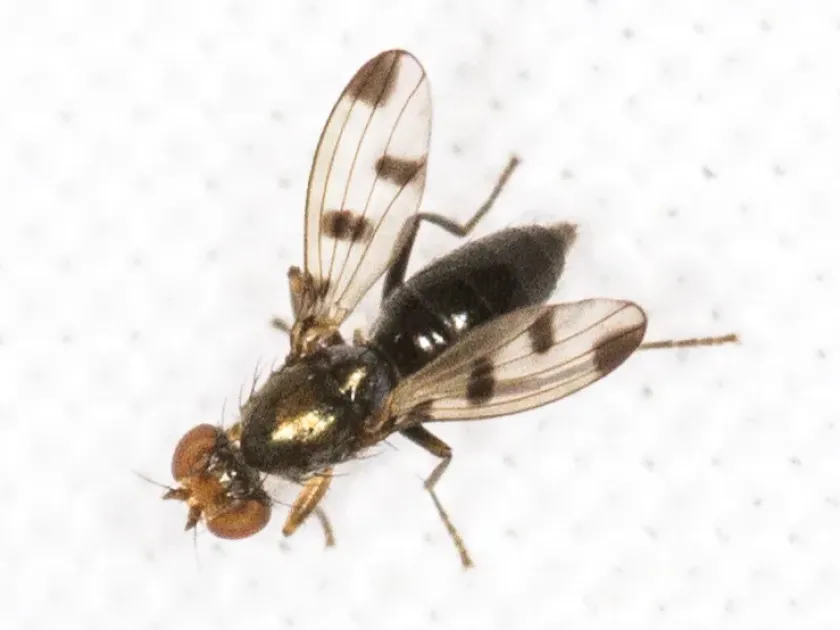
The cereal fly (Geomyza tripunctata) belongs to the Opomyzidae family, order Diptera. It is a small insect, measuring 3–4 mm, with a yellowish-brown body and characteristic dark spots on its wings.
Adults are known for their active flight during the heading period of winter cereals. The larvae are legless, whitish or yellowish, reaching up to 5 mm in length, with black mouth hooks for feeding.
This insect undergoes a complete metamorphosis: egg, three larval instars, puparium, and adult. In most regions, it has one generation per year, overwintering primarily as a puparium in the soil or stubble.
Adults are identified by their specific movement style: they scurry rapidly across grass leaves. Visual identification is often difficult due to the cryptic lifestyle of the larvae inside stems.
A key morphological feature of the species is the three dark spots on the wings, which inspired the common name. Identification in the field often requires the use of sweep nets.
What it damages
Primary crops affected by the cereal fly include winter wheat, rye, and barley. To a lesser extent, it can damage wild grass species growing in or near fields.
The most significant damage occurs during the tillering and stem elongation phases. Larvae penetrate the base of the stem, destroying the growing point, which leads to the death of the central leaf or the entire tiller.
Damage manifests as thinning of the crop stands, reduced tillering, and underdeveloped ears. Affected plants often appear stunted compared to their healthy neighbors.
Mass outbreaks of this pest can cause yield losses of up to 20–30%. Infestation of young seedlings in the autumn is particularly dangerous, as larvae can destroy the primary shoot.
Damaged plants become more susceptible to fungal diseases because stem tissues are weakened by larval activity. Secondary infections with root rot are frequently observed.
When it appears
Adult flight usually begins in early spring when air temperatures reach +10–12°C. During this time, adults feed actively on the young shoots of cereals.
Females lay eggs directly in the soil near the base of grass stems or under leaf sheaths. The incubation period depends heavily on the temperature conditions of the region.
Larvae hatch within 10–14 days and immediately begin to bore into the plant stems. The peak of larval activity coincides with the rapid growth phase of the grain crops.
Pupation occurs inside the damaged stem or in the topsoil layer. The pupal stage lasts about two to three weeks depending on soil moisture.
In autumn, the population may produce a partial second generation during prolonged warm weather, which poses a significant risk to late-sown winter crops.
Signs of infestation
The first sign of infestation is the yellowing and wilting of the central leaf within the tiller. When pulled gently, the central leaf easily detaches from the sheath.
Upon inspecting the damaged stem, one can find the larva or signs of its activity, such as frass and damaged internal tissues at the base of the shoot.
A characteristic sign is the presence of small entry holes at the base of the stem. The area around the infestation often shows slight swelling or distortion of the stem.
In cases of autumn infestation, plants appear underdeveloped and their growth essentially stops. Fields often look patchy due to the death of individual tillering centers.
Mass infestations lead to a decrease in the density of productive stems. Visual inspection of plants during the early stem elongation phase allows for timely assessment of the economic threshold.
Control measures
A key agronomic practice for control is the strict adherence to crop rotation, ensuring spatial isolation between winter and spring cereal fields.
Deep autumn plowing helps destroy puparia residing in the soil by burying them at depths unreachable by emerging adults. Timely weed control is also essential to eliminate alternative hosts.
Application of insecticides during the peak adult flight period significantly reduces population density and prevents egg-laying in the field.
Seed treatment with systemic insecticides effectively protects young seedlings from larval damage during the early stages of crop development.
- Utilizing natural entomophages to suppress population levels.
- Monitoring adult activity using yellow sticky traps.
- Balanced nitrogen fertilization to enhance the plant's regenerative capacity.
- Sowing at optimal times to minimize crop vulnerability during peak pest activity.
Taxonomy
- Latin name
- Geomyza tripunctata
- Order
- Diptera (flies)
- Family
- Opomyzidae
- EPPO code
- GEOZTR
Discussion
No discussions yet — be the first.