
Opomyza petrei
Opomyza petrei
Description
How to identify
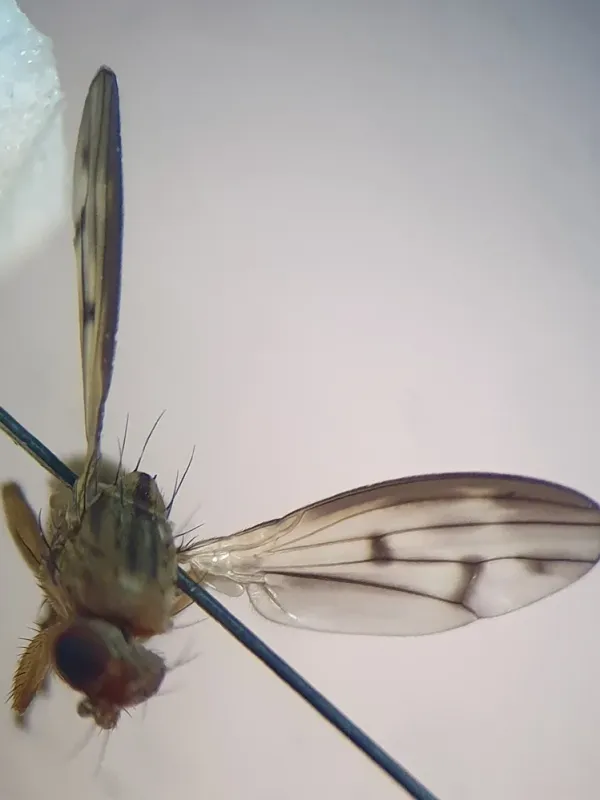
Opomyza petrei belongs to the order Diptera and the family Opomyzidae. The adult insect is a small fly, typically 3–5 mm in length, characterized by a yellowish-brown coloration.
The wings of the adult feature a distinct pattern of dark spots, which is a key morphological trait for field identification. The fly's head is equipped with antennae featuring plumose aristae, and its body is covered in sparse bristles.
The larva of the Opomyza reaches 5–7 mm in length, has an elongated cylindrical shape, and is cream-colored. It lacks legs but possesses well-developed mouth hooks adapted for feeding on plant tissues.
The life cycle includes the egg, three larval stages, pupa, and adult. The pest overwinter primarily in the egg stage, laid in the soil or at the base of host plants.
Pupation occurs in the soil or within damaged stems, after which a new generation of flies emerges, ready for mating and dispersal throughout the fields.
What it damages
The primary food source for the larvae are cereal crops, especially during early developmental stages. The most significant damage is observed in winter wheat, winter barley, rye, and some wild grasses.
Larvae penetrate the stem through the base, creating tunnels in the tissues of the young plant. This disrupts normal nutrient flow and plant development.
The damage manifests as the suppression of the central shoot, often leading to its death. Infested plants show stunted growth, reduced productivity, and an inability to form a full ear.
In cases of heavy infestation, thinning of crops and a reduction in productive stem density occur. This directly impacts grain yields, significantly reducing the economic efficiency of the crop.
The pest poses a particular risk under mild winter conditions and during early spring, when larval activity commences immediately after the resumption of cereal growth.
When it appears
Adult emergence of Opomyza petrei occurs during the spring vegetative growth of cereal crops, when temperatures become favorable for insect activity. Flies begin laying eggs in the soil near the seedlings.
The larvae emerging from the eggs immediately start feeding on young plant tissues, penetrating the growing point. The peak period of damage occurs at the onset of spring tillering.
Generally, one generation of this pest develops per season, which limits the period of damage. However, high population density in a specific year can cause substantial crop loss.
By the time the plants reach the shooting stage, the larvae finish feeding and pupate, ending their direct impact on the stems. Damage sustained prior to this stage is irreversible.
Weather conditions, such as a cool and moist spring, contribute to an extended period of insect activity, increasing risks for winter crops.
Signs of infestation
The first sign of infestation is the wilting and yellowing of the central leaf on young shoots. Agronomists often refer to this phenomenon as 'white-stem' or heart rot.
Upon inspection, one may notice entry holes at the base of the stem where the larva penetrated. Dissecting the stem reveals the larva or signs of its feeding activity.
Damaged stems are easily pulled from the leaf sheath, and the base of the stem is often rotten or destroyed. The plant stops tillering and begins to wither.
The field may appear patchy, with clusters of stunted plants easily distinguishable from the healthy, vigorously growing crops.
- Yellowing of the central leaf.
- Presence of larvae inside the stem.
- Easy detachment of the central leaf when pulled.
- Patchy thinning of the crop.
- Presence of holes in the lower part of the stem.
Control measures
Agrotechnical methods are the foundation of protection: crop rotation and maintaining a spatial distance from fields where cereals were grown in the previous year significantly reduce risks.
Early sowing of winter crops in autumn allows plants to strengthen before the mass oviposition of the pest, making them less susceptible to larval attack.
Chemical control involves the use of systemic insecticides that suppress the pest at the beginning of its activity. Treatments are conducted during mass flight and the onset of larval hatching.
Seed treatment with insecticidal agents is the most effective preventive measure to protect seedlings, providing a prolonged period of protection.
Monitoring adult populations using yellow sticky traps helps determine the optimal timing for protective sprays, thereby reducing pesticide load.
Taxonomy
- Latin name
- Opomyza petrei
- Order
- Diptera (flies)
- Family
- Opomyzidae
- EPPO code
- OPOMPE
Discussion
No discussions yet — be the first.