
Wheat shoot fly
Opomyza germinationis
Description
How to identify
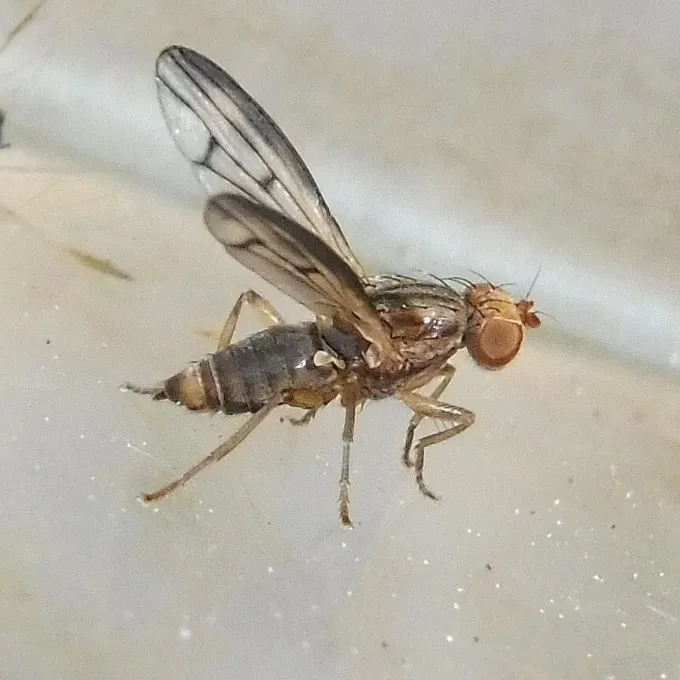
The wheat shoot fly (Opomyza germinationis) belongs to the order Diptera, family Opomyzidae. This small insect measures approximately 3–4 mm in length and possesses a yellowish-brown body.
The wings are clear with a distinctive dark spot at the tip and along the margin, which is a key morphological feature for identifying the species. The larva is cylindrical, legless, and white or cream-colored, reaching up to 5 mm in length.
Adult flies are highly mobile and capable of migrating long distances to find suitable cereal fields for oviposition. They are commonly found on wild grasses in meadows and pastures.
The life cycle is closely linked to soil temperature and the developmental stages of host plants. Females lay eggs in the soil near seedlings or directly into the base of the stem.
The overwintering stage is the egg, which is highly resistant to freezing temperatures, allowing the population to survive harsh winters successfully.
What it damages
Damage is primarily caused by the larvae, which burrow into the stems of cereal crops in the spring. Winter wheat, rye, and barley are the most susceptible, especially during early growth stages.
The larva feeds on the heart of the central shoot, destroying the growing point and resulting in the death of the primary stem.
The level of damage is directly correlated with population density and sowing dates. Early-sown winter crops have a lower risk as they reach a more robust stage before larval emergence.
Infested plants become vulnerable to secondary fungal infections, as pathogens enter through the feeding tunnels, further accelerating plant decline.
Severe infestations can lead to thin crop stands, often necessitating reseeding of the affected field sections.
When it appears
The flight of the first generation of adults occurs in spring, typically in April or early May, coinciding with the active growth of winter cereals and the emergence of spring crops.
A second peak of activity occurs in the summer, when flies lay eggs on wild grasses, which act as reservoirs for the population between seasons.
The most damaging period for larvae is during the tillering and stem elongation phases when stems are tender and easily accessible.
Temperature optimization for larval development is between 12 and 18 degrees Celsius, making the pest particularly dangerous during cool and humid springs.
In hot and dry conditions, insect development slows down, and larval survival rates drop significantly due to the desiccation of the topsoil.
Signs of infestation
The first indicator of infestation is the yellowing and wilting of the central leaf of the main tiller, which can be easily pulled out during field inspection.
Upon careful examination of the stem, one can locate the entry hole created by the larva near the base or just above the tillering node.
Affected plants stop tillering and appear stunted compared to healthy, vigorously growing neighbors.
In cases of heavy infestation, distinct patches appear in the field where plants have died off completely, failing to form a productive crop canopy.
Splitting the stem longitudinally reveals the larva itself or signs of its feeding activity, such as dark excrement and damaged inner tissues.
Control measures
The primary control measure is adhering to optimal sowing dates, which allows plants to develop past the most susceptible stage before peak oviposition.
Agronomic practices include thorough autumn plowing and the destruction of grassy weeds, which serve as alternative hosts for the pest.
Chemical control involves treating seeds with systemic insecticidal dressings, providing long-lasting protection to young seedlings.
- Application of pyrethroid-based insecticides during the peak flight period of the adult flies.
- Maintaining a proper crop rotation to avoid planting cereals in the same fields repeatedly.
- Monitoring adult population levels using yellow sticky traps or water traps.
- Maintaining spatial isolation between new winter cereal plantings and previous year's fields.
Biological control methods are limited but include the use of natural enemies, which can help regulate population densities under field conditions.
Taxonomy
- Latin name
- Opomyza germinationis
- Order
- Diptera (flies)
- Family
- Opomyzidae
- EPPO code
- OPOMGE
Discussion
No discussions yet — be the first.