
Trichodorus obesus
Trichodorus obesus
Trichodorus obesus is a species of free-living, ectoparasitic nematodes within the Trichodoridae family. These microscopic organisms are recognized as significant agricultural pests that live in the soil and feed on plant roots without entering the root tissue entirely.
What the section contains
Trichodorus obesus
Taxonomically, it belongs to the phylum Nematoda. The species is characterized by a relatively stout and cylindrical body, which contributes to the common name "stubby root" associated with its genus. It possesses a specialized, curved feeding stylet, known as an onchiostylet, used to pierce root cells.
Beyond direct damage, this nematode is a known vector for tobacco rattle virus (TRV) and other tobraviruses. Their ability to migrate through thin films of water in soil pores allows them to move between roots and transmit viruses efficiently.
The life cycle consists of an egg stage, four larval stages, and an adult stage. All stages except the egg are capable of feeding on plant roots. Development is highly dependent on environmental conditions, particularly soil moisture and temperature levels.
Trichodorus obesus is known for its resilience and ability to survive in various soil types, particularly light, sandy soils. Their population dynamics are tightly coupled with the presence of host plants and the overall moisture status of the rhizosphere.
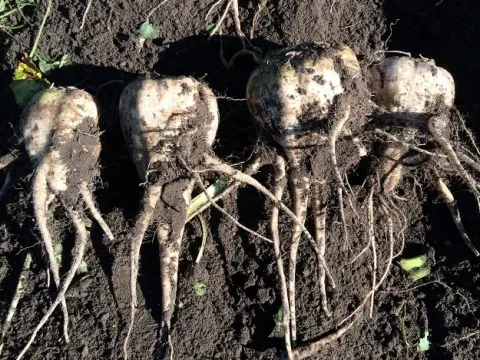
This nematode affects a wide variety of plants, including potatoes, sugar beets, tomatoes, and ornamental bulbs. By feeding on the root tips, they impede root development, leading to the characteristic "stubby root" syndrome, where roots appear blunt and stunted.
The damage to the root system significantly reduces the plant's ability to uptake water and nutrients, resulting in stunted growth, leaf chlorosis, and reduced yield. In potato cultivation, infection often leads to severe internal and external defects on tubers.
The transmission of viruses by Trichodorus obesus causes additional systemic symptoms, such as leaf distortion, mosaics, and stunted stems. These viral infections can be more devastating than the direct damage caused by the feeding activity itself.
Root damage also facilitates secondary fungal and bacterial infections. In fields with high infestation levels, the crop may show reduced quality and marketable yield, often leading to total loss of specific sections of the field.
- Significant reduction in crop yield and quality.
- Systemic infection of crops with tobacco rattle virus.
- Internal necrosis and corky rings on potato tubers.
- Increased susceptibility of plants to secondary soil-borne pathogens.
Nematode activity is highest during periods of moderate temperatures and adequate soil moisture. Spring and autumn are typically the peak seasons for their movement and feeding, as soil conditions are optimal for their survival and reproduction.
These nematodes prefer sandy and well-drained soils. In dense, clay-rich soils, their mobility is limited, which often keeps their population densities lower compared to light soil environments.
During dry summers or cold winters, the nematodes may move to deeper soil profiles to escape temperature extremes or moisture deficit. They can remain in a quiescent state, waiting for favorable conditions to resume feeding.
The spread of the nematode across fields is heavily influenced by human activity, particularly the movement of farm machinery, tools, and infected soil or plant material. This makes early detection and sanitation practices vital.
Host plant availability is a critical factor for population growth. Continuous monoculture of highly susceptible crops can lead to explosive increases in nematode populations within a single growing season.
The most common field sign is the presence of uneven patches of crop growth, often referred to as "spotty" growth. Plants in these patches are typically shorter and appear chlorotic compared to the surrounding healthy plants.
Root system inspection often reveals roots that are blunt, thickened, or show excessive branching without healthy root hairs. Necrotic spots at the root tips are a clear indication of ongoing nematode feeding.
Symptoms related to viral infections, such as mottled leaves or distorted growth patterns, are strong indicators that Trichodorus obesus may be present as a virus vector. These symptoms often become visible later in the growing season.
For accurate diagnosis, specialized laboratory procedures such as soil sampling and extraction of nematodes are necessary. Morphological identification under a microscope confirms the presence of the species.
In seedlings, the attack by nematodes can lead to early wilting or complete failure of the plant to establish, as the compromised root system cannot support the metabolic needs of the growing plant.
Effective management begins with strict crop rotation. Avoiding susceptible host plants for several years is an essential strategy to reduce the population density of Trichodorus obesus in infested fields.
The use of antagonistic cover crops, such as certain oil radish or mustard varieties, can act as a biofumigant. These plants produce chemicals that are naturally toxic to nematodes, helping to suppress their numbers before the main crop is planted.
Chemical control via soil nematicides is an option, though it is often reserved for high-value crops due to environmental concerns and high costs. Applications must be precisely timed with the nematode's active cycle.
Maintaining high soil fertility and optimal irrigation management helps crops outgrow moderate nematode pressure. Furthermore, cleaning all equipment after working in infested areas is mandatory to prevent cross-contamination.
Integrated Pest Management (IPM) programs emphasize early detection through routine soil testing, enabling farmers to make informed decisions before severe damage occurs to the crop.