
Tropical rust of maize
Physopella zeae
Tropical rust of maize is a serious fungal disease caused by the obligate pathogen Physopella zeae. It belongs to the Basidiomycota division and is a major concern for maize producers in tropical regions.
What the section contains
Tropical rust of maize
The fungus is a specialized parasite that exclusively targets the Zea mays plant, relying on the host's living tissues to complete its complex biological life cycle.
Its development involves the formation of uredinia, which erupt through the leaf epidermis to release massive amounts of urediniospores. These spores are highly mobile and easily disseminated by wind currents.
The taxonomic classification confirms it as a distinct rust species, requiring specific environmental conditions like high humidity and warmth to thrive, which dictates its limited geographic distribution.
Diagnostic verification in professional laboratories involves microscopic examination of the urediniospores to distinguish Physopella zeae from other common maize rust species.
The primary impact of the disease is the destruction of photosynthetic tissue on maize leaves. As the fungus consumes nutrients, it severely limits the plant's capacity to produce grain.
Infection results in premature leaf senescence and death, which significantly reduces the filling time for ears and causes a substantial decrease in overall grain weight and crop quality.
High levels of infestation can lead to yield losses exceeding 50% in susceptible cultivars, especially during periods of prolonged wet weather that favor pathogen multiplication.
Compromised structural integrity of the leaves and stems often makes the plants more susceptible to lodging, causing mechanical harvest losses and further reducing marketable production.
Furthermore, the weakened condition of the plant makes it a prime candidate for secondary infections by other opportunistic pathogens, complicating overall crop health management.
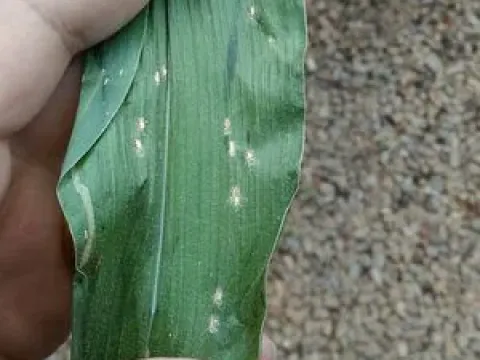
Symptoms initially appear as small, subtle, light-colored flecks on both leaf surfaces, which eventually enlarge and evolve into distinct, raised brown or rust-colored pustules.
These pustules, or uredinia, are typically arranged in dense, often linear patterns following the leaf venation, creating a rusty appearance on the foliage.
As the infection progresses, the surrounding leaf tissue becomes chlorotic, eventually turning necrotic. Severe infestations cause the entire leaf to wither and curl, leading to premature defoliation.
In humid conditions, the pustules rupture, revealing a powdery mass of orange-brown spores that can easily be transferred to healthy plants through wind or irrigation water.
Towards the end of the season, the pustules may transition to a darker color as the fungus produces teliospores, marking the transition to a resting state.
The most effective strategy for managing tropical rust is the deployment of resistant maize hybrids, which are developed specifically to withstand infection in high-risk tropical zones.
Cultural management practices include the thorough incorporation of crop residues into the soil, which helps eliminate potential overwintering sites for the fungal spores.
Fungicide application is a necessary tool in intensive production systems. Systemic fungicides, particularly those containing triazoles, are highly effective when applied at the onset of symptoms.
- Implementing crop rotation to break the pathogen's life cycle.
- Monitoring weather patterns to predict and prepare for potential outbreaks.
- Maintaining proper plant nutrition to boost inherent resistance.
Early detection and prompt action remain the cornerstone of control, as once the disease becomes widespread in a field, total eradication is difficult to achieve.