
Trichodorus
Trichodorus
Description
How to identify
Trichodorus is a genus of free-living ectoparasitic nematodes belonging to the class Dorylaimia. The body of these microscopic worms is cylindrical with rounded ends, typically reaching a length of 0.5 to 1.5 mm.
The primary distinguishing feature of the genus is its specific mouthpart, known as an onchiostyle, which is shaped like a curved spear (stomatostyle). This organ allows the nematodes to pierce the cell walls of plant roots for feeding.
These organisms live in the soil, moving through thin layers of moisture between soil particles. They can survive in various soil types but prefer light, sandy, and loamy soils where movement is easier.
The life cycle of Trichodorus consists of an egg, four larval stages, and an adult. Transition between stages involves molting, with the entire development occurring within the rhizosphere of host plants.
Species identification often requires professional laboratory analysis, as it is nearly impossible to distinguish between different Trichodorus species visually without microscopic examination.
What it damages
Trichodorus affects a wide range of agricultural crops, including potatoes, sugar beets, ornamental bulbs, tobacco, and numerous vegetable species. They cause damage by depleting the root system and hindering normal plant development.
The main danger is not just direct feeding on sap but the ability of these nematodes to transmit dangerous plant viruses. Specifically, they are active vectors of the Tobacco Rattle Virus (TRV) and the Pea Early-Browning Virus.
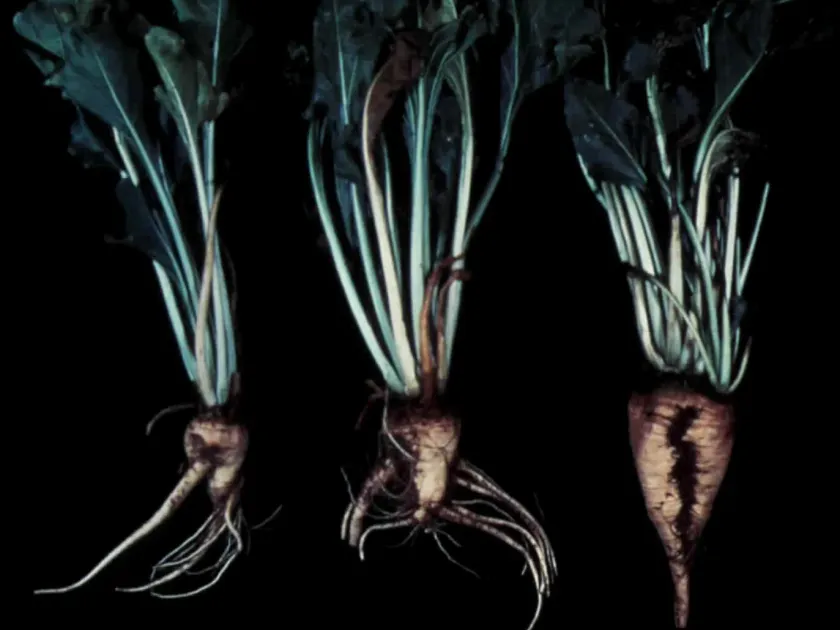
As a result of nematode feeding, necrotic lesions form on roots, leading to stunted growth, chlorosis, and general plant decline. In cases of severe infestation, the root system becomes shortened, stubby, and inefficient.
On potato tubers, Trichodorus activity triggers the development of specific spots, arcs, and internal necrosis, which significantly reduce the market quality of the produce. Damaged tubers are often unsuitable for long-term storage.
Crop losses in heavily infested fields can reach 30–50% or more, especially under conditions favorable for nematode population growth.
When it appears
Trichodorus activity is directly dependent on soil moisture levels and ambient temperature. Optimal conditions for their development occur in spring and autumn, when soil moisture is most stable.
Nematodes prefer moderately warm soil, but they maintain viability across a wide temperature range. During periods of extreme drought or deep soil freezing, they enter a state of reduced activity.
Population spikes usually correlate with the planting of susceptible crops, which provide a constant food source for the nematodes throughout the growing season.
The spread of Trichodorus to new areas occurs primarily through contaminated soil adhering to farm equipment, workers' footwear, or with infected planting material carrying soil residues.
The life cycle is continuous under favorable conditions, which is why monitoring population levels is recommended prior to the start of the planting season.
Signs of infestation
Signs of Trichodorus infestation in the field often appear as patches of stunted, low-growing plants that stand out against the background of healthier crops. Poor root nutrition leads to inadequate nutrient uptake.
Leaves of infected plants may yellow, curl, or exhibit mosaic patterns, which are often consequences of the viral infection transmitted by the nematodes. Plants often appear "starving" despite adequate fertilizer application.
Inspection of the root system reveals brown necrotic lesions and a lack of fine, functional feeder roots. In areas where nematodes have pierced the tissues, secondary fungal pathogens often enter, exacerbating the damage.
When affected by viral diseases transmitted by Trichodorus, tubers or fruits develop specific patterns such as necrotic lines or rings, which ruin their appearance and commercial value.
Diagnosis is challenging because symptoms are often confused with nutrient deficiencies or soil-borne fungal diseases, necessitating professional soil analysis.
Control measures
Effective protection against Trichodorus relies on an integrated approach combining agronomic and chemical control methods. Crop rotation is the foundation, preventing the growth of susceptible host plants in the same location for consecutive years.
Weed management is a crucial practice, as weeds can act as reservoirs for both the nematodes themselves and the viruses they transmit. Keeping fields weed-free significantly reduces the risk of pathogen spread.
- Using certified, healthy planting material free from signs of infestation.
- Regular disinfection of farm tools and machinery before moving to clean fields.
- Application of specialized nematicides when pest populations reach threshold levels.
- Optimizing sowing dates to minimize the contact between young roots and the peak activity of nematodes.
Biological control methods, such as the use of cover crops (e.g., certain mustard or radish varieties) capable of suppressing nematode populations in the soil, are showing promising results in integrated pest management systems.
The use of chemical agents must be strictly regulated, as most nematicides are highly toxic compounds that require rigorous adherence to safety protocols.
Causes diseases · 3
Discussion
No discussions yet — be the first.