
Septoria brown spot
Septoria glycines
The causal agent of this disease is the fungus Septoria glycines, belonging to the Ascomycota division. It is a specific pathogen that targets the soybean plant exclusively.
What the section contains
Septoria brown spot
The fungus overwinters on infected crop residues buried in the soil. It can persist as pycnidia and mycelium for up to two years, remaining a viable source of primary inoculum.
Primary infection is initiated by conidia, which are splashed by rain or wind-blown onto the lower leaves of the soybean plant during the early growth stages.
Once the conidia land on a host surface with sufficient moisture, the fungus germinates and invades the plant tissue through stomata or mechanical wounds.
Inside the host, the pathogen develops an extensive mycelial network, subsequently producing new fruiting bodies known as pycnidia to facilitate secondary cycles of infection.
Brown spot affects all aerial parts of the soybean plant, including cotyledons, leaves, stems, and pods, particularly during the reproductive growth phases.
Infection results in premature leaf drop, which significantly reduces the photosynthetic area and limits the plant's ability to fill pods effectively.
Severe infestations can lead to poor seed quality and reduced seed weight, directly impacting the marketable yield and overall profitability for the farmer.
In cases where the infection moves to the stems and pods, structural damage can occur, weakening the plant and increasing susceptibility to secondary pathogens.
Economic losses vary based on environmental conditions but can reach significant levels if the disease is not managed during the critical flowering period.
Initial symptoms are usually observed during the early vegetative stages on lower leaves, especially following periods of high humidity and rainfall.
Warm temperatures ranging from +20°C to +28°C combined with high moisture create the ideal environment for the rapid spread of the disease.
Extended periods of dry weather typically suppress the development of the pathogen, although it can remain dormant until favorable conditions return.
Peak disease prevalence often coincides with the R1 to R3 growth stages, where the canopy density provides a stable, humid microclimate for fungal growth.
As the season progresses toward maturity, the intensity of new infections may decrease, but the pathogen successfully prepares for overwintering on residue.
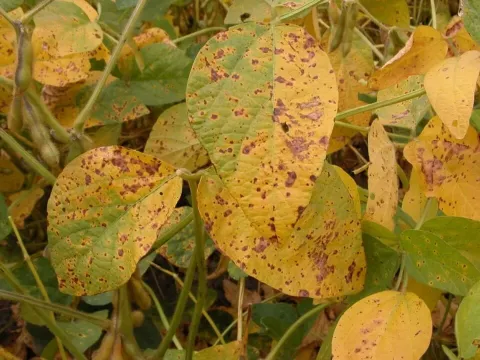
The characteristic symptoms are small, angular, dark brown spots that appear on both leaf surfaces, often bounded by the leaf veins.
Yellow or chlorotic halos frequently surround these dark spots, which helps in identifying the disease during field scouting assessments.
A closer inspection with a magnifying lens reveals tiny black specks, which are the pycnidia of the fungus, located within the center of the lesions.
Stem and petiole lesions manifest as dark brown, elongated spots that may coalesce, leading to severe localized necrosis or cracked tissue.
Massive leaf infection causes the lower canopy to yellow and drop prematurely, often referred to as the 'firing' effect in soybean fields.
Crop rotation is the primary defense strategy, as it effectively interrupts the life cycle of the fungus by eliminating the host crop for a period.
Deep tillage to bury crop debris is highly recommended, as it speeds up the decomposition process and reduces the availability of the primary inoculum.
Using certified, disease-free seed and applying appropriate seed treatments can significantly lower the risk of early-season infection and improve emergence.
Foliar application of fungicides containing triazoles or strobilurins is effective in controlling the disease during the critical vegetative and reproductive stages.
- Selection of soybean varieties with known resistance to leaf diseases.
- Effective weed management to prevent the hosting of pathogens.
- Ensuring proper plant spacing to improve airflow within the canopy.
- Balanced nutrition to maintain overall plant health and vigor.