
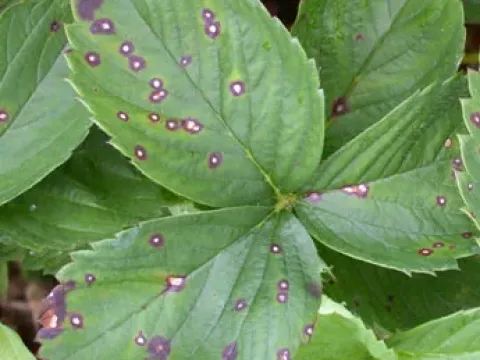
Strawberry leaf spot
Septoria fragariae
The causative agent of strawberry leaf spot is the fungus Septoria fragariae. It is a widespread pathogen that significantly affects the leaves, petioles, and stolons of the strawberry plant.
What the section contains
Strawberry leaf spot
The fungus overwinters in infected plant debris, primarily in the form of pycnidia. These small, black, flask-shaped structures produce vast quantities of conidia when favorable conditions arise.
Dissemination of the spores primarily occurs through water splash, wind-driven rain, and contaminated farming equipment. The pathogen requires moisture to successfully infect the plant tissue.
Once the conidia land on a host, they germinate and penetrate the epidermis. The fungal hyphae then grow intercellularly, absorbing nutrients and causing localized cell death.
Septoria fragariae is a hemibiotroph that causes characteristic necrotic lesions. Understanding its biology is essential for developing effective integrated pest management strategies.
The primary impact of this disease is the reduction of the functional leaf area. As leaves are decimated, the plant's ability to perform photosynthesis is severely compromised.
Infection leads to reduced sugar accumulation in the fruits, resulting in smaller, poor-quality berries. In severe cases, marketability is entirely lost due to unattractive appearance.
Long-term damage includes weakened plant vitality. Because the plant cannot store enough carbohydrates for the winter, it becomes susceptible to frost damage and may die during cold months.
The disease can also affect the runners and petioles, weakening the overall structure of the strawberry plant and limiting the production of new daughter plants for propagation.
Cumulative damage over several seasons can cause a decline in the entire plantation, leading to significant economic losses and the necessity of premature replanting.
The disease typically appears in spring when temperatures become mild and moisture levels are high, often coinciding with the onset of the strawberry growth cycle.
High humidity throughout the growing season, especially during rainy summers, provides optimal conditions for repeated infection cycles and rapid pathogen proliferation.
The most active period for disease progression is usually before and during the harvest, as the dense canopy of the plants traps humidity near the crown and leaves.
Late summer and autumn are critical for the accumulation of overwintering structures. If debris is not managed after harvest, the pathogen will successfully survive until next spring.
Early-season monitoring is vital, as the initial infections in spring dictate the intensity of the disease pressure for the remainder of the year.
The earliest symptoms are small, round, reddish-brown or purple spots on the upper leaf surface. These spots are often barely visible at first but expand as the fungus grows.
As the lesions mature, the centers turn white or light gray, while the characteristic dark purple or reddish-brown border remains, making the spots very distinct.
The development of small black dots, known as pycnidia, within the centers of these white lesions is the definitive sign of Septoria fragariae infection.
If the infection is severe, the lesions coalesce, covering large parts of the leaf tissue, which then yellows, withers, and dies, leading to premature leaf drop.
- Reddish-purple small spots appearing on leaf surfaces.
- Progression of spots to a white or gray center.
- Formation of dark pycnidia in the center of necrotic lesions.
- Widespread yellowing and death of older leaves.
Cultural control is the first line of defense. This includes maintaining proper plant spacing to ensure good airflow and reducing humidity levels around the foliage.
Sanitation is critical; all dead or diseased leaves should be removed and destroyed (burned or buried) to eliminate the primary sources of inoculum in the field.
When selecting a planting site, choose well-draining soil and locations with plenty of sunlight to promote rapid drying of the foliage after rain or irrigation.
Fungicide applications may be necessary in high-pressure areas. Use them as part of an integrated program, focusing on preventive treatments during the early growing season.
Always source disease-free nursery stock and implement crop rotation to break the life cycle of the pathogen in the soil.