
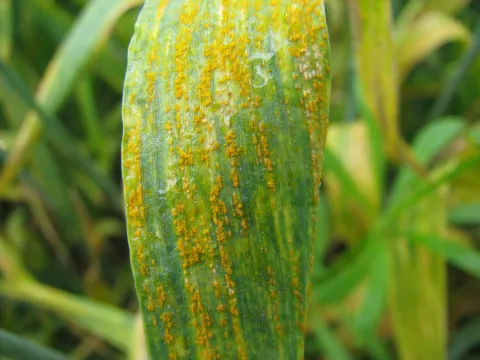
Stripe rust
Puccinia striiformis
The causative agent of the disease is an obligate parasite, the basidiomycete fungus Puccinia striiformis from the Pucciniaceae family. This pathogen is highly specialized, primarily affecting cereal crops and surviving as urediniomycelium in infected plant tissues or volunteer plants.
What the section contains
Stripe rust
Stripe rust is an infectious disease capable of rapid spread through urediniospores, which are wind-dispersed over long distances. The fungus develops as an intracellular parasite, depleting the resources of the host plant.
The life cycle includes the formation of urediniospores in characteristic pustules. Unlike other rust species, this pathogen prefers moderately cool conditions, making it particularly dangerous at the beginning of the growing season.
The fungus infects the host tissue by penetrating through the stomata, after which the mycelium rapidly spreads through the leaf intercellular spaces. The parasite's metabolic activity leads to impaired photosynthesis and premature death of infected organs.
Systematically, this organism belongs to the kingdom Fungi, phylum Basidiomycota, class Pucciniomycetes. Its high variability and the emergence of new physiological races make the breeding of resistant varieties extremely challenging.
The main crops at risk are bread and durum wheat, barley, rye, and a wide range of wild grasses. The disease affects both winter and spring cereal grains.
The pathogen causes the most severe damage in regions with temperate climates, where spring temperatures promote active spore production. Infection can affect crops at all growth stages, from emergence to milk maturity.
The damage manifests as a significant reduction in the photosynthetic leaf area, directly leading to yield loss. Under intense disease development, grain losses can exceed 50%, especially if the flag leaf is infected early.
Infected grain often becomes shriveled and characterized by low test weight and poor baking quality. Disruption of nutrient flow to the grain prevents the plant from realizing its full yield potential.
Beyond direct yield loss, stripe rust weakens plant immunity, making crops more susceptible to secondary infections like septoria or root rots, which further worsens the overall phytosanitary condition of the field.
The most active manifestation of symptoms occurs at air temperatures between +5°C and +15°C under high humidity. Spring fogs and heavy dew are key factors triggering mass spore dispersal.
Primary infection sites often emerge where the fungus overwintered on winter crops or cereal volunteers. Once temperatures exceed +5°C, the mycelium activates, forming the first pustules.
In summer, when stable heat above +25°C sets in, fungal development slows down significantly; however, if night rain occurs, the epiphytotic can continue until the dough stage of the grain.
The pathogen's incubation period is highly dependent on environmental conditions and can range from 7 to 14 days under optimal humidity. The rapid succession of spore generations allows the infection to cover vast areas in a very short time.
Urediniospore dispersal occurs via air currents. Wind patterns can carry spores over tens or hundreds of kilometers, making it impossible to contain an outbreak without immediate control measures.
The main diagnostic feature is the appearance of characteristic lemon-yellow pustules arranged in narrow, parallel stripes along the leaf veins. This "striped" pattern is what distinguishes this rust from other species.
- In the early stages, spots appear as small chlorotic dots.
- Later, powdery uredinia form on leaves, stems, and even glumes.
- With heavy infection, the leaf is completely covered in yellow spore dust and eventually dries out.
- The ears of infected plants often remain stunted or sterile.
- At the end of the season, black telia covered by the epidermis may appear instead of yellow pustules.
When inspecting fields, visual signs include leaf deformation and curling, which result from intense mycelial infection. The characteristic yellow powder easily rubs off when touching the affected leaf.
Differential diagnosis requires observing spore arrangement: stripe rust pustules are always aligned with the veins and are elongated in shape. In contrast, leaf rust (brown rust) is characterized by a random, scattered distribution of pustules across the leaf blade.
The foundation of control is the use of resistant and tolerant cereal varieties. Agronomic practices include managing volunteer plants and following crop rotation, which prevents the buildup of infectious inoculum in the soil.
Chemical control involves the timely application of fungicides from the triazole and strobilurin groups. Applications are most effective at the first signs of disease to stop spore spread to the upper plant canopy.
An important technique is early planting for spring crops and adhering to optimal winter planting dates so plants can strengthen before the peak activity of the pathogen. Managing plant density helps improve airflow within the canopy.
It is necessary to avoid excessive nitrogen fertilization, which triggers lush vegetative growth and increases susceptibility. Balanced nutrition, especially potassium fertilizers, helps strengthen cell walls.
Monitoring the phytosanitary state of crops from early spring allows for the detection of local hotspots and targeted spraying. A systemic approach to plant protection ensures yield preservation even in years favorable for rust development.