
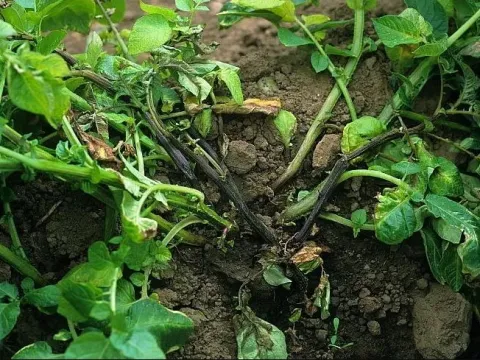
Potato black leg
Potato black
Potato black leg is a devastating bacterial disease caused primarily by Pectobacterium atrosepticum (formerly known as Erwinia carotovora subsp. atroseptica). This pathogen belongs to the Pectobacteriaceae family.
What the section contains
Potato black leg
The bacteria are Gram-negative, rod-shaped, and motile. They produce pectinolytic enzymes that break down the middle lamellae of plant cell walls, leading to tissue maceration and cell death.
The pathogen persists in infected tubers, soil, and crop debris. It is primarily spread through contaminated seed potatoes and survives from season to season in cool, moist environments.
As a phytopathogen, it exploits the vascular system of the potato plant. Its systematic classification places it within the Proteobacteria phylum, reflecting its high adaptability to plant tissues.
The disease cycle is heavily influenced by environmental factors, particularly moisture levels in the soil, which determine the rate of bacterial colonization in the potato stems.
The disease causes significant economic loss in potato production worldwide. It affects the plant at all growth stages, from sprout emergence to harvest and storage.
In addition to potatoes, the pathogen can infect other solanaceous crops, such as tomatoes, peppers, and eggplants, making crop rotation essential for managing the disease.
In the field, infected plants exhibit stunted growth and reduced vigor. If the infection occurs early, the entire plant may collapse before tuber formation even begins.
Post-harvest damage is severe, as infected tubers undergo soft rot. A single infected tuber in a storage bin can quickly spread bacteria to healthy neighbors, causing widespread decay.
The overall impact of the disease includes reduced marketability of the produce, decreased yield quality, and high costs associated with rigorous phytosanitary measures.
Black leg development is favored by cool, wet conditions, especially during the early part of the growing season when soil temperatures range between 15°C and 25°C.
Initial infection occurs shortly after planting, often manifesting as failure of sprouts to emerge. In prolonged rainy periods, the bacteria multiply rapidly within the stem tissues.
The disease peak usually occurs during the vegetative phase of the plant. High humidity and poor drainage promote the movement of bacteria from the seed tuber into the stems.
Late-season outbreaks are often associated with high soil moisture, which creates anaerobic conditions. These conditions are ideal for the development of tuber soft rot.
During the harvest, high humidity and temperature fluctuations facilitate the transition of the pathogen from the soil to the tubers through harvesting wounds.
The most distinctive sign is the development of a blackened, mushy lesion at the base of the stem. The affected tissue becomes soft and emits a pungent, foul odor.
Foliar symptoms include yellowing of the leaves, starting from the lower part of the plant, followed by upward rolling and eventual wilting of the entire canopy.
Upon cutting an infected stem, one may observe internal browning of the vascular tissue. This discoloration indicates the systemic spread of the bacterial infection.
In tubers, the infection appears as dark, sunken areas. These areas are usually clearly defined from healthy tissue, with the internal flesh often turning into a soft, creamy mass.
- Blackened base of the potato stem.
- Upward rolling and yellowing of foliage.
- Foul-smelling soft rot of the stem base.
- Rapid wilting of the plant.
- Soft, mushy decay inside the tubers.
The primary control strategy is the use of high-quality, certified, disease-free seed tubers. Avoid planting in soils with poor drainage or a history of bacterial outbreaks.
Implementing a strict crop rotation cycle of at least 3–4 years helps reduce the bacterial population in the soil. Weed control is essential to minimize secondary hosts.
Regular field inspections (roguing) are necessary to identify and remove infected plants immediately, ensuring they are destroyed away from the planting site.
Disinfecting agricultural equipment and storage facilities is critical to prevent the spread of the pathogen. Treat seed tubers with approved bactericides where permitted.
After harvest, tubers must be stored under cool, dry conditions with adequate ventilation to prevent the development of soft rot during the winter months.