
Potato late blight
Wild potato
Description
How to identify
The causative agent of late blight is Phytophthora infestans, an oomycete belonging to the Stramenopila kingdom. It acts as a highly destructive plant pathogen often mistaken for a fungus.
The biological cycle involves both asexual reproduction, producing sporangia that disperse via wind or water, and sexual reproduction leading to oospore formation.
Oospores can survive in soil for several years, serving as a persistent source of inoculum that can infect subsequent crops even after a rotation period.
Upon germination, the pathogen penetrates host tissues through stomata or directly through the cuticle, initiating a rapid colonization of the plant tissue.
The pathogen thrives in cool, moist conditions with temperatures between 15–22°C and relative humidity exceeding 90%, which are ideal for its development.
What it damages
Late blight primarily attacks potatoes and tomatoes. It is capable of causing devastating crop failures globally if environmental conditions favor the pathogen.
The disease affects all aerial parts of the potato plant, including leaves, stems, and petioles, leading to complete destruction of the green photosynthetic canopy.
Tubers are susceptible to infection through spores washed into the soil by rain or direct contact with infected foliage during the harvesting process.
Infected tubers often develop dry, firm rots, which eventually facilitate secondary infection by soft-rotting bacteria, leading to total tuber loss.
Economic damage is substantial, involving not only direct yield loss but also increased costs for intensive fungicide programs and storage issues.
When it appears
Primary inoculum sources include infected cull piles, volunteer potato plants, and contaminated seed tubers planted at the start of the season.
Epidemic outbreaks typically begin as the canopy closes, creating a high-humidity microclimate within the lower levels of the potato foliage.
Periods of prolonged leaf wetness, often caused by heavy dew, fog, or frequent rain, are the most critical times for disease acceleration in the field.
The speed of infection is highly dependent on environmental variables; in favorable conditions, a potato field can be completely blighted within two weeks.
Late in the season, lower temperatures often suppress fast spread, but the pathogen persists in the tubers, ensuring survival for the next growing cycle.
Signs of infestation
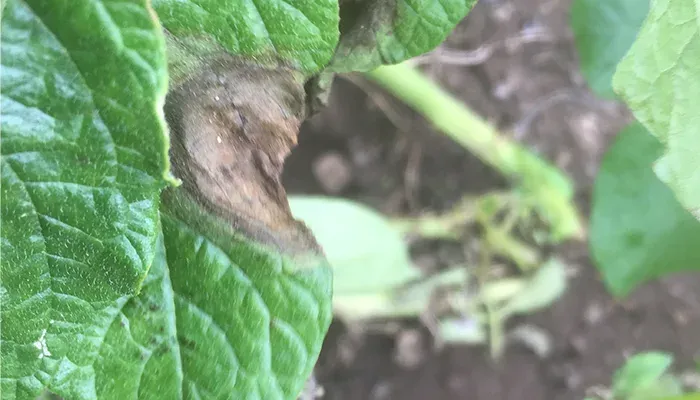
Symptoms initially appear as small, dark, water-soaked spots on the leaves, which rapidly expand into large, necrotic lesions surrounded by a pale chlorotic halo.
In high humidity, a distinct white, fuzzy layer of mycelium and sporangia appears on the undersides of leaves, clearly visible to the naked eye.
Stem lesions are dark brown or black, eventually causing the collapse of the plant and giving off a distinct, unpleasant odor of decaying vegetation.
Tubers exhibit irregular, slightly sunken, dark-colored spots on the skin; the internal tissue shows a characteristic reddish-brown, dry, granular rot.
- Rapidly spreading dark leaf lesions.
- White fuzzy growth under leaves.
- Stem girdling and decay.
- Internal reddish-brown tuber rot.
Control measures
Integrated pest management includes selecting resistant cultivars and ensuring the use of certified, disease-free seed potatoes for every planting season.
Cultural practices such as adequate hilling to cover tubers, removing volunteer plants, and proper spacing to improve air circulation are highly recommended.
Fungicide application must be systematic, starting before the appearance of symptoms and strictly following a preventative schedule based on weather forecasts.
Resistance management is crucial; therefore, alternating between systemic and contact fungicides with different modes of action is essential to prevent resistance.
Destroying the haulms (foliage) prior to harvest is a critical final step to prevent spores from contacting the tubers and to harden the potato skins.
Causes diseases · 1
Discussion
No discussions yet — be the first.