
Polyscytalum pustulans
Polyscytalum pustulans
Polyscytalum pustulans is a fungal plant pathogen that belongs to the group of Deuteromycetes. It is primarily known for causing skin spot disease in potatoes.
What the section contains
Polyscytalum pustulans
The fungus survives in the soil and on infected tubers, acting as a persistent inoculum source in fields where potatoes have been grown previously.
Its biological cycle is dependent on soil moisture and cool temperatures, which favor the production of conidia that infect emerging tubers.
As a specialized parasite, it targets the periderm and outer tissues of potato tubers, colonizing them during the growing season.
The pathogen is known for its ability to persist in a latent form, making it difficult to detect infected tubers during the sorting process.
The primary host for Polyscytalum pustulans is the potato plant. The disease it triggers, skin spot, is a common issue in potato production globally.
The damage starts at the stolon and tuber level, where the fungus penetrates through lenticels and minor skin abrasions.
The economic impact is primarily related to the loss of aesthetic value of the tubers, making them unsuitable for the fresh market or high-quality processing.
Severe infections can negatively affect tuber health, potentially leading to increased susceptibility to storage rots during winter storage.
Reduction in crop yield occurs when the infection spreads to the stems, causing localized necrosis and disrupting the plant's nutrient transport.
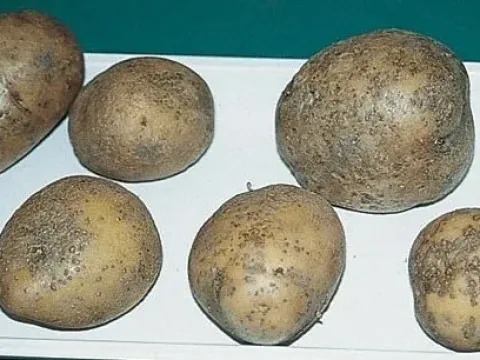
Symptoms appear as small, circular, or irregular dark spots on the skin of potato tubers, which can be easily confused with other common blemishes.
Distinctive pustules may develop, often surrounded by a dark, necrotic border, giving the affected area a rough texture.
Under favorable conditions, the infected areas may merge, covering large portions of the tuber surface with discolored, sunken patches.
These spots are often more visible after washing the tubers, which reveals the characteristic contrast between healthy and infected periderm.
In dormant storage, the spots may remain relatively stable, but they serve as visible indicators of contamination in the seed lot.
The most effective strategy is the use of pathogen-free seed tubers, sourced from certified commercial providers to ensure minimal infection.
Implementing a crop rotation scheme of at least three to four years without potatoes is essential to reduce the soil-borne inoculum.
Careful handling during harvest is crucial, as the fungus enters the tuber primarily through mechanical wounds or physical damage to the skin.
Storage management, specifically maintaining adequate ventilation and cool temperatures, prevents the rapid progression of the disease within stored batches.
- Chemical seed treatments prior to planting to inhibit fungal growth.
- Proper soil drainage to mitigate excessive moisture during tuber initiation.
- Sanitation of equipment to prevent the spread of soil-borne spores.