
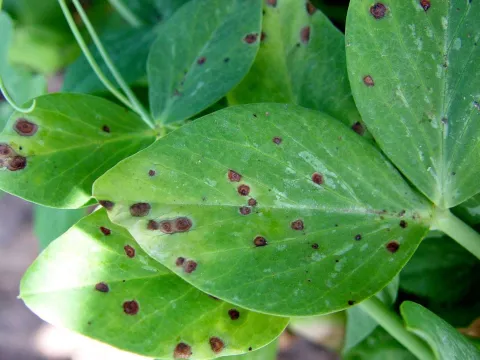
Pea ascochyta blight
Mycosphaerella pinodes
Pea ascochyta blight is a serious fungal disease caused by Mycosphaerella pinodes (anamorph Ascochyta pinodes). It belongs to the Ascomycota phylum and is a major threat to pulse production globally.
What the section contains
Pea ascochyta blight
The pathogen is highly adaptable and can survive as mycelium or reproductive structures (pycnidia and perithecia) in infected crop residue and within the soil profile for several seasons.
It has a broad host range among legumes, including peas, vetch, and chickpeas. The disease is transmitted primarily through infested seeds and airborne spores dispersed from field debris.
Understanding the life cycle of Mycosphaerella pinodes is crucial, as the fungus undergoes both sexual and asexual reproduction, facilitating rapid spread under favorable conditions.
Laboratory diagnosis involves isolating the pathogen from plant tissues to differentiate it from other leaf spot diseases such as Ascochyta pisi or Phoma medicaginis.
The economic impact of ascochyta blight is significant, with yield losses often ranging from 20% to 50% depending on the severity of the infection and the timing of the outbreak.
Severe infestations lead to reduced seed weight and quality. Infected seeds often show discoloration and reduced germination vigor, impacting both planting value and marketability.
Plants affected by the blight exhibit reduced photosynthetic area, which limits the grain-filling capacity and overall crop productivity. In extreme cases, seedling death results in thin stands.
The fungus also causes foot rot symptoms, weakening the stems and leading to lodging, which complicates harvesting operations and further lowers the net yield per hectare.
High levels of infection in seed lots can make the harvest unsuitable for export or human consumption, leading to severe financial losses for producers.
Infections typically begin early in the season when spores from overwintering residue splash onto emerging pea seedlings during rainfall events.
The disease flourishes during periods of high humidity and moderate temperatures (15°C to 25°C). Frequent showers in late spring and early summer trigger rapid disease spread.
The pathogen remains active throughout the flowering and pod-filling stages, as these periods coincide with higher vegetative density and canopy moisture accumulation.
As the season progresses, secondary infection cycles occur quickly. Spores are easily disseminated by wind and rain, infecting upper leaves and developing pods systematically.
By late summer, the fungus shifts toward the reproductive stage, colonizing the stems and pods to form overwintering structures that will initiate the next year’s cycle.
The disease manifests as small, dark brown or purplish spots on the leaves and stems. As lesions expand, they often exhibit a target-like concentric ring pattern.
Stem lesions often turn into dark, elongated, or sunken cankers, particularly near the soil line. This foot rot can cause the plant to wilt and collapse prematurely.
Pods show characteristic sunken, dark brown lesions. Small, black fruiting bodies called pycnidia appear within these spots, which are a hallmark of the fungal pathogen.
In highly infected crops, the entire canopy may turn yellow and wither prematurely. Under high moisture conditions, a sparse gray mycelial growth may be visible on the lesions.
- Dark brown, circular lesions on foliage.
- Sunken stem cankers leading to lodging.
- Black pycnidia present within lesions.
- Deformed, spotted, or blighted pea pods.
- General chlorosis and rapid senescence of the plant.
Crop rotation is the most effective cultural practice; a break of at least 4 years between pea crops is recommended to reduce the pathogen load in the soil.
Seed treatment with systemic fungicides is essential to protect young seedlings from early infection. Only use certified, disease-free seed tested for the presence of the pathogen.
Deep plowing and residue management are vital to ensure that infected debris is buried, promoting rapid microbial degradation of the fungal structures.
Foliar application of fungicides, particularly during the early bloom phase, is recommended in regions with high disease pressure to protect pods and sustain leaf health.
Integrating resistant or tolerant pea varieties into the farm plan is the most sustainable approach to long-term blight management, reducing dependence on chemical inputs.