
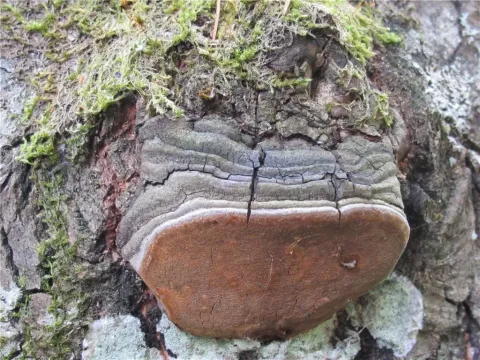
False aspen fungus
Phellinus igniarius
The false aspen fungus (Phellinus igniarius) is a perennial basidiomycete fungus belonging to the genus Phellinus. It is a common and destructive plant pathogen that primarily affects deciduous trees.
What the section contains
False aspen fungus
The fruiting bodies are hard, hoof-shaped, and woody in texture. Their upper surface is dark gray to black, often cracked and weathered, while the underside consists of a brown pore surface.
The flesh (context) of the fungus is dense and dark brown, which is a key diagnostic feature. As a perennial species, the fruiting body adds new layers of pores annually, often appearing as distinct growth rings on the underside.
It spreads via airborne basidiospores that colonize susceptible trees through wounds in the bark, such as frost cracks, broken branches, or logging injuries. Once established, the mycelium penetrates deep into the heartwood.
While often associated with aspen, the Phellinus igniarius species complex includes variants that infect a wide range of broadleaved hosts, making it a widespread problem in forest ecosystems.
This fungus is a major cause of white trunk rot in various hardwood species, particularly aspens, birches, alders, and willows. It causes significant structural degradation of the wood.
The mycelium breaks down both lignin and cellulose, leading to a soft, spongy decay in the center of the trunk. This process significantly reduces the mechanical strength of the tree.
Trees affected by advanced stem rot are highly susceptible to windthrow and breakage. This poses a major safety risk in managed forests and urban environments where trees might fall during storms.
Economic damage is substantial, as infected logs are often unsuitable for lumber or high-quality timber production, leading to major losses in forestry operations and timber harvesting.
Furthermore, the decay caused by this fungus can drastically reduce the lifespan of the tree, leading to premature mortality and hindering the regeneration of affected forest stands.
The most visible sign of an infection is the presence of hard, perennial fruiting bodies (conks) attached to the trunk of the tree, typically near old branch stubs or damage sites.
Internally, the wood shows evidence of extensive white rot. On a cross-section of a fallen or cut tree, this is often marked by distinct black zone lines that separate the decayed wood from sound tissue.
The bark near the site of infection may appear sunken, distorted, or cracked. In some cases, localized swelling around the attachment point of the conk indicates significant internal wood degradation.
In the final stages of the disease, the trunk may become hollowed out. A dull, hollow sound when tapping the trunk with a mallet or an increment borer can confirm the presence of interior decay.
Crown symptoms, such as thinning foliage, stunted growth, and dieback of the upper branches, often become apparent when the rot has reached a critical stage of damage to the internal structure.
Sanitation cutting is the primary management strategy. Removing infected trees helps reduce the local spore load and limits the spread of the pathogen to neighboring healthy trees in the stand.
Good silvicultural practices are essential to prevent infection. Avoiding damage to the bark and stems during thinning or harvesting operations significantly lowers the risk of fungal colonization.
Dead and decaying wood should be cleared from forest areas, as these materials can serve as long-term reservoirs for the fungus, allowing it to continue producing spores and infecting new hosts.
In orchard or park settings, pruning wounds on susceptible species should be kept clean and, if necessary, treated with protective coatings to prevent spore germination at the site of the injury.
Monitoring for signs of decay in susceptible stands allows for early intervention, ensuring that high-value trees are protected or harvested before they become completely degraded by rot.