
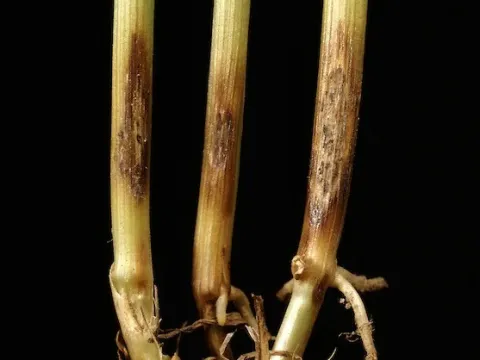
Eyespot of cereals
Pseudocercosporella herpotrichoides
The causal agent of eyespot is the fungus Pseudocercosporella herpotrichoides (also known as Oculimacula yallundae or Oculimacula acuformis). It is a persistent soil-borne pathogen that thrives in temperate climates.
What the section contains
Eyespot of cereals
The fungus survives as mycelium on crop debris and stubble from previous harvests. It is an obligate parasite that specifically infects the basal stem tissues of winter-sown cereals.
Spore production occurs during periods of high humidity and cool temperatures. These spores are splash-dispersed by rain onto the stems of young plants, initiating the infection cycle.
It is a highly specialized fungus that colonizes the leaf sheaths before penetrating the stem internodes. Understanding its biology is crucial for timing diagnostic checks in the field.
Unlike many other root rots, eyespot primarily affects the structural integrity of the stem base rather than the primary root system itself.
Winter wheat, barley, rye, and triticale are the primary hosts. The economic impact is particularly severe in regions with mild, wet winter seasons that favor fungal growth.
The fungus destroys the tissues of the stem base, leading to lodging, where the stems collapse and fall over. This severely hampers grain filling and nutrient translocation.
Lodged crops suffer from reduced yield, poor grain quality, and significant harvesting difficulties. In cases of high disease pressure, yield losses can exceed 50%.
The disease causes premature ripening of the crop, resulting in shriveled grains with low test weight and reduced market value.
Furthermore, weakened plants are more susceptible to other opportunistic infections and environmental stressors, leading to overall field degradation.
Primary infection occurs in the autumn during the seedling and tillering stages. The fungus remains active throughout the winter months, slowly colonizing stem tissues.
Cool, wet weather during late winter and early spring is ideal for rapid disease progression. In these conditions, the pathogen spreads effectively throughout the base of the stems.
Symptoms become most visible during early spring regrowth. Growers should monitor their fields closely during the tillering and jointing phases to assess the disease status.
Development slows down as temperatures rise in the summer, but the internal damage to the stem vascular tissue is usually irreversible by that stage.
Control measures are most effective when applied during the spring growth stage, before the fungus reaches the inner stem tissue and causes structural failure.
The characteristic sign is an oval, eye-shaped lesion on the leaf sheaths at the base of the plant. These lesions have a distinct dark brown border and a lighter center.
If the leaf sheath is peeled away, a corresponding necrotic lesion is visible on the stem itself. In advanced stages, tiny black spots may appear in the center of the lesion.
Lodging is a major diagnostic indicator, appearing in patches within the field. Affected stems often twist or bend rather than snapping cleanly at the soil line.
Field inspection should focus on the lower internodes of the tillers. A simple visual check of the stem base can confirm the presence of the typical "eyespot" pattern.
In highly humid conditions, the pathogen may produce a fine, grayish moldy growth on the surface of the lesions, containing fungal spores.
Crop rotation is the most effective cultural practice. Growing non-host crops for at least two to three years helps reduce the soil-borne inoculum significantly.
Selecting resistant or tolerant cereal varieties is a fundamental strategy for managing the risk of infection in high-pressure environments.
Chemical control via fungicides is recommended when the incidence of disease crosses the economic threshold, typically in the spring.
- Tillage practices that incorporate crop residues to speed up decomposition.
- Avoidance of excessive seeding density to reduce microclimate humidity.
- Timely application of benzimidazole or triazole-based fungicides.
Integrated pest management (IPM) focusing on early monitoring and balanced fertility helps maintain healthy stands and prevents large-scale lodging.