
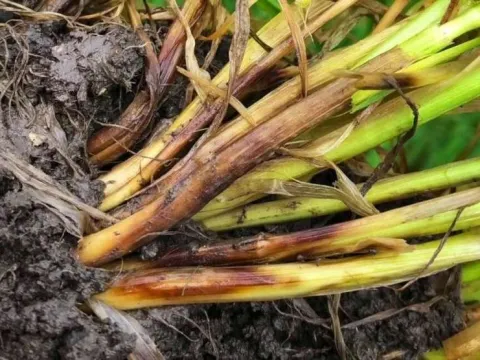
Eyespot of cereals
Phaeosphaeria herpotrichoides
Eyespot is a fungal disease affecting cereal crops, caused by the pathogens Oculimacula yallundae and Oculimacula acuformis. Previously known as Pseudocercosporella herpotrichoides, this pathogen remains a significant threat to wheat and barley worldwide.
What the section contains
Eyespot of cereals
The fungus survives as mycelium or conidia on crop residues left in the soil. It thrives in cool, moist conditions, making it particularly problematic in temperate regions with wet autumns and springs where winter cereals are grown.
Spore dispersal occurs primarily through rain splash, moving the pathogen from infected debris to the lower stems of emerging or tillering cereal plants. The infection process begins as the fungus penetrates the leaf sheaths and eventually the stem base.
The pathogen is capable of slow but persistent growth at temperatures near freezing, allowing it to remain active during winter months. Its ability to survive in the soil for several years necessitates long-term rotation planning.
Laboratory identification involves isolating the fungus on specialized nutrient media where it exhibits characteristic slow growth patterns. In the field, accurate diagnosis is based on identifying the classic lesion types on the stem base.
The primary hosts for Eyespot are winter wheat, winter barley, rye, and triticale. Various wild grasses can also host the pathogen, acting as an alternative reservoir for the inoculum between cropping seasons.
The disease severely impacts crop health by causing necrosis of the stem base. This tissue damage disrupts the plant's vascular system, hindering the transport of water and nutrients to the head, resulting in lower grain weight and yield.
The most devastating effect is stem breakage, commonly referred to as "lodging." Because the stem base is weakened, the crop collapses under its own weight, especially during high winds or rain, making mechanical harvesting extremely difficult.
Early infections during the tillering stage can lead to the death of individual stems. Later infections, occurring in the stem elongation phase, result in stunted growth and the production of shriveled, low-quality grain unsuitable for milling.
Economic losses can be substantial, often ranging from 10% to 50% depending on environmental conditions and the timing of infection. Without intervention, Eyespot can lead to total crop failure in susceptible varieties under severe pressure.
The first visual sign of Eyespot is the appearance of oval-shaped lesions on the lower leaf sheaths. These lesions typically feature a light, necrotic center surrounded by a distinct dark-brown margin.
As the infection progresses, the lesions expand and penetrate the stem base, creating the signature "eyespot" symptom. The infected tissues become structurally compromised and easily break when pressure is applied to the stem.
Inside the hollow stem, one may observe a mass of fungal growth, often appearing as a grayish, felt-like layer of mycelium. This is the primary indicator of active colonization by the pathogen.
Unlike other foot rot diseases, Eyespot is localized primarily on the lower internodes and does not cause a generalized root rot. This distinction is crucial for field diagnosis and selecting appropriate fungicide treatments.
In mature crops, heavily infected fields appear as patches of prematurely ripening plants or collapsed areas. The affected stems can be easily pulled from the ground, often breaking exactly at the point of the lesion.
Management strategies focus on breaking the infection cycle through crop rotation, with at least a 2-year gap between susceptible cereal crops. Selecting resistant or tolerant cultivars is the most effective long-term defense.
- Deep plowing to bury infected crop residues.
- Planting high-quality, certified seed.
- Avoiding excessively early sowing dates to reduce autumn infection risk.
- Targeted fungicide application during the spring growth phase.
Chemical control usually involves the use of systemic fungicides, particularly those belonging to the benzimidazole or triazole classes. Early season monitoring is essential to determine if the disease threshold has been met.
Managing crop density is vital, as overly dense stands create a humid microclimate at the soil level, which drastically increases the rate of spore transmission. Balanced fertilization helps ensure the crop maintains sufficient vigor to resist the pathogen.