
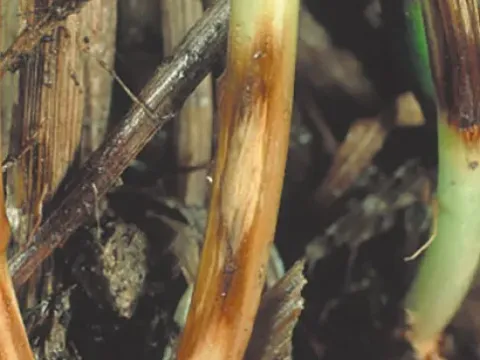
Eyespot of cereals
Oculimacula yallundae
Oculimacula yallundae is a fungal pathogen responsible for causing eyespot disease in various cereal crops. Classified within the division Ascomycota, this fungus specifically targets the stem base of plants, leading to weakened structures and potential lodging.
What the section contains
Eyespot of cereals
The fungus survives as mycelium on crop debris within the soil, allowing it to persist between growing seasons. Under cool and moist conditions, it produces conidia that are splashed by rainfall onto the lower leaf sheaths of young seedlings.
Biology of the pathogen is centered on the infection of the basal tissues. Once inside the stem, the fungus develops slowly, digesting the plant tissues and causing the characteristic lesions that eventually lead to structural failure.
Understanding the life cycle of Oculimacula yallundae is essential for accurate diagnosis. Agronomists often distinguish it from similar diseases by the presence of characteristic eye-shaped lesions and the timing of initial infection during the tillering phase.
Effective management requires knowledge of environmental triggers. The pathogen is highly dependent on extended periods of leaf wetness and moderate temperatures, which facilitate the spread of spores and the establishment of the disease in the field.
The primary hosts of this pathogen include winter wheat, barley, and rye. Damage is characterized by the breakdown of stem tissues near the soil line, which restricts the flow of water and nutrients to the grain head.
Yield loss is primarily caused by lodging, where the weakened stems break under the weight of the grain. This makes the crop difficult to harvest and significantly reduces both the volume and quality of the yield.
In addition to lodging, severe infections cause premature ripening and the production of shriveled, low-weight grain. Infected plants demonstrate stunted growth and a reduced number of productive tillers per square meter.
The disease also leaves the crop susceptible to secondary pathogens that thrive on weakened plant tissues. This complex infection process often leads to increased physiological stress on the plant, further reducing overall field productivity.
Economically, eyespot can cause significant losses in high-yielding intensive systems. If left uncontrolled during favorable seasons, the infection can spread rapidly, affecting a large percentage of the crop stand.
Infection cycles typically begin in the autumn. As winter wheat emerges, spores dispersed by rain splash colonize the lower leaves. This initial autumn infection period is critical for the buildup of the disease inoculum.
During the winter months, if the temperature remains above freezing, the fungus continues to colonize the stem base slowly. This persistence during the dormant season allows for deeper penetration into the stem tissues by the time spring arrives.
Spring is a period of high activity for the pathogen, as frequent rainfall events facilitate the spread of conidia from the basal lesions to higher leaves. This secondary spread increases the prevalence of the disease throughout the canopy.
The pathogen thrives at temperatures between 5 and 15 degrees Celsius. These conditions are ideal for the development of the fungal mycelium, while high humidity levels are essential for the production of new spores.
As summer temperatures rise, the disease development typically slows down. However, by the time high heat arrives, the damage to the stems is often irreversible, and the focus shifts to minimizing further losses before harvest.
The most recognizable symptom is the appearance of oval or elliptical spots on the leaf sheaths, which often transition to the stem. These spots are light-colored in the center and surrounded by a dark brown or black margin, resembling an eye.
When the infection is severe, the lesions coalesce and form a necrotic ring around the base of the stem. This destruction of the stem integrity is what leads to the characteristic lodging of the crop during the grain-filling stage.
In humid conditions, a greyish fungal mass might be visible on the surface of the lesions. This mass consists of conidia, which serve as the primary source for further spread of the infection to healthy tissues.
Plants affected by eyespot often exhibit premature yellowing and lodging. Even before the stem breaks, the general lack of vigor in the crop stand can be an indicator of underlying basal infections.
- Oval-shaped lesions on leaf sheaths.
- Dark, eye-like borders on stem lesions.
- Softening and decay of the stem base.
- Lodging of stems during grain maturation.
- Premature yellowing of the lower leaves.
Cultural control is the first line of defense, emphasizing the importance of crop rotation. Rotating away from susceptible cereal hosts for at least 2 to 3 years helps deplete the soil inoculum and reduces the risk of infection.
Effective residue management is vital. Incorporating crop debris deeply into the soil accelerates decomposition, which helps eliminate the primary survival niches of the pathogen between seasons.
Chemical control involving fungicides is commonly used during the tillering stage. Applications should be timed based on field assessments to ensure maximum efficacy before the fungus penetrates the internal stem tissues.
Selecting resistant varieties is highly recommended for regions with a history of eyespot issues. Genetic resistance significantly decreases the reliance on chemical inputs and provides a stable foundation for crop management.
Managing nitrogen levels to prevent overly dense canopies can create a microclimate that is less favorable for fungal spread. Reducing humidity within the lower canopy is an effective strategy for limiting the severity of the outbreak.