
Eyespot of cereals
Ramulispora herpotrichoides
The causative agent of eyespot is the fungus Ramulispora herpotrichoides (formerly known as Pseudocercosporella herpotrichoides). It is a specialized pathogen that primarily targets the base of cereal stems.
What the section contains
Eyespot of cereals
The fungus produces septate mycelium and small, needle-like conidia. These conidia are spread by rain splash from the soil surface onto the lower leaves and stems of young cereal plants.
It overwinters as mycelium on crop debris or within infected living plants. The pathogen can persist in the soil for several years if the crop rotation is not managed properly.
Laboratory identification involves isolating the fungus on agar media, where it produces characteristic slow-growing, grayish-white colonies. Microscopic examination of the conidia is essential for precise confirmation.
This fungus thrives in cool, wet environments, making it a persistent threat in temperate climates where autumn and spring conditions are typically damp.
Eyespot affects a wide range of cereals, including wheat, barley, rye, and triticale. Wheat is particularly susceptible, and the disease is a major concern for intensive cereal production systems worldwide.
The fungus attacks the stem base, colonizing the outer leaf sheaths and eventually the stem itself. This colonisation disrupts the plant's vascular system, hindering the transport of water and nutrients.
Structural damage to the stem base results in lodging, where the stems collapse under the weight of the developing grain. This lodging makes harvesting difficult and leads to significant yield losses.
Grain quality is negatively impacted by the disease, leading to shriveled grains and reduced protein content. In severe outbreaks, the entire crop may be flattened, leading to complete field loss.
The economic impact of eyespot is significant, often necessitating the use of fungicides to protect yield potential and ensure grain quality standards for milling.
Infection typically begins in the autumn as soon as the seedlings emerge. The fungus is most active during cool, damp weather, with an optimal temperature range of 5°C to 15°C.
Mild winter temperatures allow the pathogen to continue its slow development on the stem tissues, ensuring a significant amount of inoculum is present when spring growth begins.
The peak of disease spread occurs during the spring, coinciding with the rapid growth of the cereal crop. Rain splashes facilitate the upward movement of spores from the soil onto the stem base.
As temperatures rise during the summer and moisture levels drop, the production of new conidia declines. However, the existing infection continues to compromise the stem integrity until maturity.
The life cycle concludes as the crop matures, with the fungus surviving on the stubble, waiting to re-infect the next susceptible crop in the rotation.
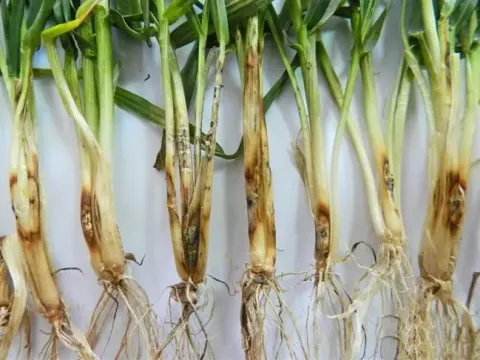
The earliest symptom is the appearance of brownish-green, oval-shaped spots on the lower leaf sheaths. These spots eventually extend to the stem, forming characteristic lesions.
The most distinctive feature is an eyespot lesion: an elliptical spot with a dark brown border and a lighter, necrotic center. These lesions can merge to form a girdling rot around the stem.
- Elliptical necrotic spots on the lower stem base.
- Dark borders forming an eye-shaped appearance.
- Softening of stem tissues leading to lodging.
- Grayish fungal growth within the lesions under humid conditions.
- Premature ripening and uneven crop height.
A cross-section of an infected stem often reveals browning of the internal tissues, indicating deep colonization by the fungal mycelium.
Effective crop rotation is the primary management strategy. A break of at least 2–3 years between susceptible cereal crops is recommended to reduce the inoculum level in the soil.
Cultural practices, such as incorporating crop residues into the soil, help speed up the decomposition of stubble, thereby reducing the survival period of the fungus.
Chemical control using fungicides during the early stem elongation phase (tillering) is highly effective. Application timing is critical to prevent the fungus from reaching the inner stem layers.
Selecting resistant or tolerant cereal varieties is a sustainable approach to minimize the risk of eyespot infection. Modern breeding programs focus on genetic traits that inhibit fungal colonization.
Avoiding high sowing densities improves airflow at the base of the crop canopy, which helps keep the environment drier and less conducive to the germination of fungal conidia.