
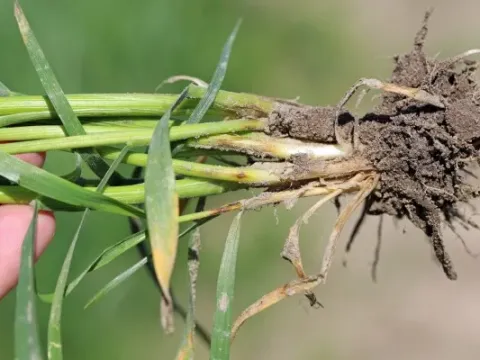
Eyespot of wheat
Pseudocercosoporella herpotrichoides
The causal agent of eyespot disease is the fungus Pseudocercosporella herpotrichoides (teleomorph Oculimacula yallundae), a widespread pathogen of small grains.
What the section contains
Eyespot of wheat
The fungus is a soil-borne pathogen that persists primarily in crop residues such as stubble, remaining infectious for several years in the field.
Spore production (conidia) is highly dependent on environmental moisture; rain splashes move the spores from the soil surface to the base of the stems.
This fungus is characterized by slow development, meaning the initial infection can go unnoticed until significant damage to the vascular tissues occurs.
It prefers mild, damp conditions, which are typical for temperate climates, making it a persistent problem in winter wheat production zones.
Eyespot primarily affects winter wheat, barley, rye, and triticale, causing severe physiological stress to the developing plants.
By colonizing the base of the stem, the fungus disrupts the transport of water and nutrients, leading to poor grain filling and stunted growth.
One of the most damaging effects of the disease is the weakening of the stem structure, which predisposes the crop to severe lodging during wind or rain.
Yield losses can be significant, often ranging from 10% to 30%, depending on the timing of the infection and the climatic conditions during the growing season.
The disease also increases the risk of secondary infections by other root rot pathogens, further compounding the damage to the crop health.
Infection typically begins in the autumn when spores land on newly emerged seedlings, especially if wheat is sown early into fields with previous residues.
During the winter months, if temperatures remain mild, the mycelium continues to colonize the leaf sheaths and stem tissue, slowly progressing inward.
The spring period sees a significant increase in pathogen activity as the plant enters the rapid growth phase and the environment remains humid.
The stem elongation phase is the most critical time for infection, as the fungus spreads across the nodes and internodes at the base of the plant.
As the crop reaches maturity, the fungus stops its active spread, reverting to a dormant phase on the remaining stalks, waiting for the next planting cycle.
The classic symptom is an elliptical spot on the leaf sheaths, which often develops a light, straw-colored center with a dark brown or black margin.
These spots give the disease its name, "eyespot," as they resemble a human eye when observed on the base of the stem or leaf sheath.
Infected plants may exhibit whiteheads, where the grain fails to fill properly, making the crop look as if it is ripening ahead of schedule.
At the base of the stem, dark fungal mycelium may be visible during damp weather, often localized within the necrotic tissue of the stem base.
Widespread lodging across the field is a major indicator of severe infection, where stems break at the softened necrotic lesions near the soil level.
Crop rotation is the most effective cultural practice, with a gap of at least two to three years between susceptible cereal crops to break the disease cycle.
Good stubble management, including deep tillage, helps speed up the decomposition of residues, thereby reducing the primary inoculum source.
Selecting resistant or tolerant varieties is a vital part of integrated pest management (IPM) to maintain productivity in high-risk areas.
Fungicides should be applied based on threshold assessments, targeting the period from tillering to early stem elongation for maximum effectiveness.
- Avoiding early planting dates to reduce exposure during peak infection windows.
- Using balanced nitrogen fertilization to avoid excessive canopy growth.
- Applying systemic fungicides (e.g., prothioconazole or carbendazim) when necessary.