
Fasciation
Fasciation
Description
How to identify
Fasciation is not an infectious disease in the classical sense, but rather a morphological anomaly of shoot development. It is characterized by the transformation of the apical meristem from a point into a line, leading to tissue proliferation and stem fusion.
Biologically, this phenomenon is often triggered by phytoplasmas, viruses, fungal infections, as well as mechanical damage or sudden hormonal imbalances within plant tissues.
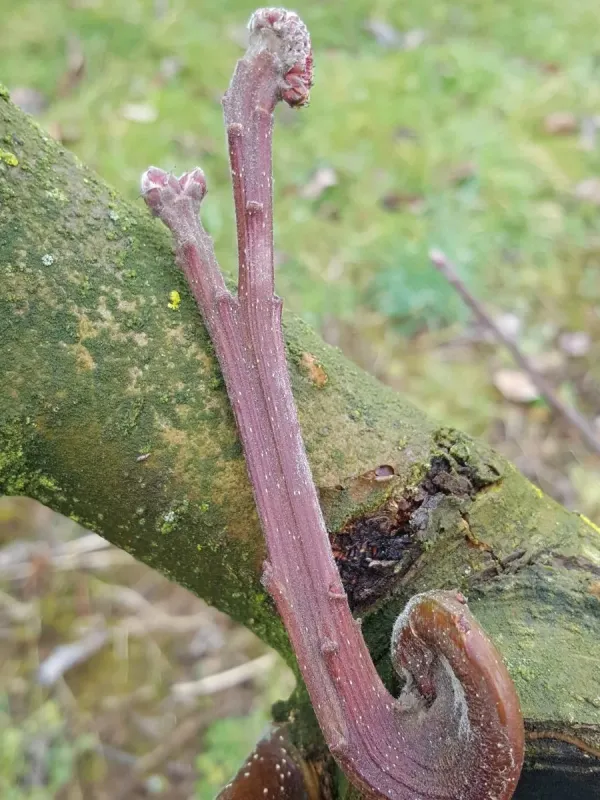
Fasciation is most commonly observed in ornamental, fruit, and vegetable crops. Visually, it manifests as a flattened, ribbon-like stem that appears as several shoots fused into one powerful growth.
This anomaly disrupts the normal distribution of nutrients and water throughout the plant. Often, a large number of underdeveloped buds or fruits form at the site of deformation, which lack any commercial value.
It is important to distinguish between random genetic mutation and fasciation caused by pathogens, as in the latter case, the plant becomes a source of infection for others.
What it damages
This anomaly affects a wide range of agricultural and ornamental crops, including tomatoes, cucumbers, strawberries, chrysanthemums, lilies, and many others.
In vegetable crops, fasciation often affects the fruits: they acquire ugly, multi-chambered shapes, which significantly lowers their market appearance and suitability for long-term storage.
Fruit trees may suffer from branch fasciation, making their wood brittle and less resistant to wind loads. This frequently leads to shoot breakage during periods of active vegetation.
Ornamental plants lose their varietal appeal. Flowering becomes asymmetrical, and inflorescences may take on an unnaturally flattened appearance, which is unacceptable for floral products.
In severe cases, fasciation provokes general growth inhibition of the entire plant, as the abnormal shoot acts as a "black hole" consuming major resources at the expense of other parts.
When it appears
Signs of fasciation are most noticeable during periods of intensive spring growth, when active cell division occurs in the meristems.
If the cause is a phytoplasma infection, the spread of the disease often correlates with the activity of insect vectors, such as leafhoppers, which appear in early summer.
Weather conditions, such as sharp temperature fluctuations in spring, can act as a trigger for the manifestation of latent genetic predispositions to deformation.
In greenhouse operations, symptoms can occur regardless of the season if the nutritional regimen is disrupted or aggressive chemical growth regulators are used, causing hormonal imbalance.
The duration of symptom persistence depends on the plant's longevity: in herbaceous plants, it is a seasonal phenomenon, whereas in woody plants, the pathology can persist throughout the branch's life.
Signs of infestation
A key sign is the ribbon-like deformation of the stem, which becomes flat, wide, and often has longitudinal grooves on the surface.
The tip of the shoot often becomes fan-shaped. Leaves on the affected part are arranged chaotically and densely, sometimes fusing into single plates of irregular shape.
Flower stalks acquire an uncharacteristic thickness, and the number of buds clustered in one place increases abnormally, creating "bunches" or fused inflorescences.
A disruption of phyllotaxis (the order of leaf arrangement) is observed, where the normal spiral or opposite growth pattern is completely disrupted.
Flowers often have extra petals, fused stamens, or pistils, making the pollination process impossible or extremely difficult.
Control measures
The primary control method is culling and removing infected specimens if the anomaly is caused by an infectious agent.
It is important to control insect vectors (leafhoppers, aphids) using modern systemic insecticides to prevent the transmission of pathogens.
Adhering to crop rotation and spatial isolation of plantings from wild weeds, which can be natural reservoirs for phytoplasma infections, is highly recommended.
Using balanced mineral nutrition helps avoid stress, which often triggers physiological forms of fasciation not associated with infections.
If fasciation is a singular mutational event, the damaged shoot should be carefully pruned to prevent further development of the anomaly and wasted plant energy.
Causes diseases · 1
Discussion
No discussions yet — be the first.