
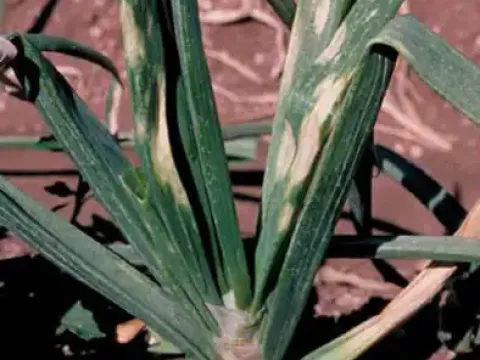
Garlic mosaic
Garlic mosaic
Garlic mosaic is caused by a complex of viruses, the most prominent being the Garlic mosaic virus, which belongs to the Potyvirus genus. It is an obligate parasite that lacks cellular structure and replicates solely within the living host plant cells using its genetic machinery.
What the section contains
Garlic mosaic
The virus is primarily transmitted vegetatively through infected planting material, such as garlic cloves or bulbils. Additionally, the garlic mite and various species of aphids serve as critical vectors, transmitting viral particles while feeding on healthy tissues.
Systematically, this pathogen belongs to viruses with single-stranded RNA. Because there are no direct chemical treatments for plant viruses, management focuses on agrotechnical practices to prevent the infection from spreading throughout the fields.
Viral particles possess a filamentous structure and can survive in bulbs for extended periods, being passed down through generations when using "saved" seed stock. Cleaning the planting material is the only reliable way to suppress the disease.
External symptoms of the disease can be masked by nutrient deficiencies or other fungal conditions, making laboratory analysis via ELISA or PCR methods essential for accurate identification.
The disease affects both cultivated and wild species of the Allium genus, including winter and spring garlic, onions, and shallots. The greatest economic damage is caused to garlic crops, where virus accumulation in the cloves occurs very rapidly.
Infected plants exhibit stunted growth and development, which directly impacts the biomass of the aerial parts. As a result, the vegetative cycle is shortened, and the accumulation of organic matter in the bulb is compromised.
Damage to chloroplasts due to viral activity leads to a sharp decrease in photosynthesis intensity. Plants become weakened, making them secondarily susceptible to fungal infections like Fusarium wilt or neck rot.
Yields can decrease by 30–50% or more under severe infestation. Bulbs are formed small, often deformed, and exhibit poor shelf life, rendering them unsuitable for long-term storage or commercial sale.
The gradual accumulation of the virus in the seed stock over several years leads to the total degeneration of the variety, making the crop economically non-viable for production.
The primary symptoms of garlic mosaic appear in early spring, immediately after emergence. This is because the virus activates in tandem with the resumption of physiological processes in the overwintered bulb.
During the active vegetation period, especially in warm and dry weather, the rates of viral replication within tissues accelerate. The peak of visual symptom expression occurs during the phase of active leaf mass growth.
Secondary infection spread within the field occurs in mid-summer, when the population density of insect vectors reaches its peak. At this time, healthy plants can be infected through contact with aphids or mites migrating from infected foci.
High air humidity conditions indirectly favor pest development, which in turn influences the rate of mosaic spread. However, the virus itself does not depend on climatic conditions directly, persisting in plant tissues throughout the year.
In autumn, the virus fully concentrates in the developing bulb, where it undergoes a period of dormancy along with the plant, preparing for the next vegetation cycle.
The main sign is a chlorotic mosaic on the leaves, manifesting as alternating light green or yellow stripes and streaks running parallel to the leaf veins.
Characteristic symptoms also include marked deformation of the leaves, which may curl, become wrinkled, or take on a wavy shape. In advanced cases, significant plant stunting is observed.
At later stages of development, necrotic spots may appear on the leaves, indicating the death of affected tissue segments due to viral impact and secondary microflora.
- Yellowing of leaf tips in early stages.
- Reduction in the intensity of green color across the foliage.
- Decrease in the diameter of the false stem.
- Uneven bulb maturation.
Visual signs may be pronounced in cool weather and smooth out as temperatures rise; however, even in the absence of symptoms, the virus remains in the tissues and continues to suppress the plant.
The key management method is the use of virus-free planting material obtained through tissue culture ("in vitro"). This is the only way to effectively break the chain of infection.
Regular phytosanitary roguing must be performed—identifying, removing, and destroying diseased plants from the field, including the root zone, to reduce the overall inoculum pressure.
Rigorous control of insect vector populations, particularly garlic mites and aphids, is crucial. Applying appropriate insecticides and acaricides during critical growth phases helps limit the spread of the virus.
Adherence to crop rotation practices helps minimize the presence of infection vectors in the soil. It is not recommended to return garlic to the same plot for at least 3–4 years.
Disinfection of gardening tools after working in infested areas is mandatory, as the virus can be spread mechanically via tools that come into contact with the sap of infected plants.