
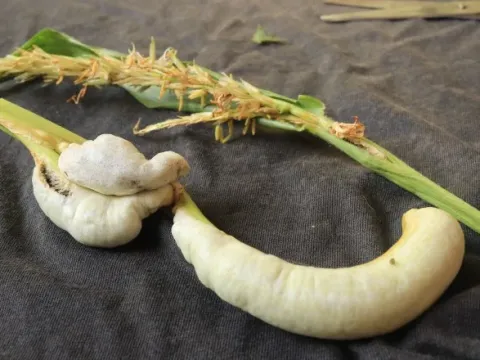
Giant Ergot
Claviceps gigantea
Giant Ergot (Claviceps gigantea) is a highly specialized fungal pathogen belonging to the Ascomycota phylum and the order Hypocreales, known for causing significant infections in maize.
What the section contains
Giant Ergot
Unlike common ergot, this species is distinguished by the formation of unusually large, elongated sclerotia that can grow significantly beyond the glumes of the corn cob.
The fungus is an obligate parasite, completing its life cycle by infecting the corn ovaries during the pollination phase when the plant is most vulnerable to spore landing.
Its survival strategy relies on sclerotia that overwinter in the soil and, upon specific temperature and moisture triggers in the spring, produce stromata that release ascospores.
The biology of C. gigantea is tightly linked to environmental conditions, requiring high humidity and moderate temperatures for successful spore dispersal and infection initiation.
The primary host for Claviceps gigantea is maize (Zea mays), with the infection specifically targeting the reproductive organs, particularly the cobs.
Economic losses are driven by the replacement of grain kernels with fungal sclerotia, which significantly reduces the harvestable yield and quality of the corn crop.
The sclerotia contain toxic alkaloids that pose serious health risks to livestock if infected grain is accidentally used in feed, making crop management critical.
The presence of infection often leads to malformed cobs and physiological stress, which compromises the overall development and uniformity of the corn crop in infested fields.
Cleaning grain lots contaminated with ergot sclerotia requires specialized mechanical sorting equipment, adding to the logistical and financial burden for farmers.
Initial symptoms are characterized by the appearance of a sticky, sweet exudate known as "honeydew" on the corn silk and cobs during the flowering stage.
As the infection progresses, the most distinct sign is the development of dark brown to black, elongated sclerotia that protrude from the husk of the corn ear.
Field identification is relatively straightforward during the late development stages, as these large, hard structures are visibly distinct from healthy corn kernels.
Upon breaking a mature sclerotium, one will observe a firm, whitish to cream-colored fungal mycelium protected by a hard, dark exterior layer.
In addition to the sclerotia, the infected areas of the ear often show stunted kernel development and abnormal discoloration of the cob structure itself.
The first line of defense is the use of high-quality, certified seeds that are guaranteed to be free from ergot sclerotia contamination to prevent introduction into fields.
Deep plowing is a recommended cultural practice, as it buries sclerotia deep enough in the soil profile to prevent the successful formation and emergence of the fruiting bodies.
Implementing a robust crop rotation strategy is essential for reducing the inoculum pressure, as the fungus cannot survive long-term in the absence of a host crop.
Managing weed hosts and optimizing planting times to ensure synchronous flowering can help minimize the window during which the crop is susceptible to primary infection.
While chemical control is less common, preventative fungicide applications during the silk stage may be considered in high-risk areas to protect vulnerable flower tissues.