
Geotrichum candidum
Geotrichum candidum
Geotrichum candidum is a fungus of the order Hyphomycetes, frequently classified as an opportunistic pathogen. Its mycelium consists of hyaline, septated hyphae that fragment easily into arthrospores.
What the section contains
Geotrichum candidum
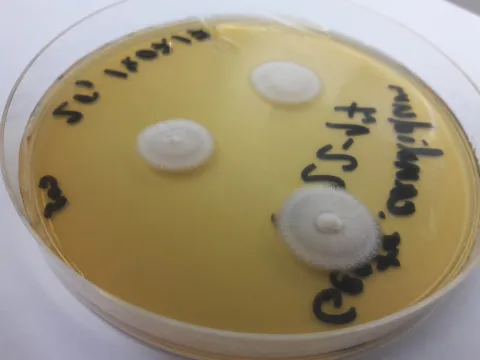
The microorganism thrives on various substrates, forming fluffy, white, or creamy colonies. In laboratory settings, it is identified by its yeast-like appearance and ability to ferment sugars.
While primarily a saprotroph, it is well-known in agronomy as a secondary pathogen causing post-harvest decay. It is ubiquitous in soil, wastewater, and plant debris.
Systematically, it belongs to the Ascomycota division. Arthrospores formed by the fragmentation of hyphae act as the primary means of dispersal in the environment.
Unlike highly specialized pathogens, this species demonstrates significant metabolic flexibility, allowing it to persist under harsh environmental conditions.
The primary hosts are succulent fruits and vegetables, particularly tomatoes, cucumbers, and melons. It also frequently infects citrus fruits and root crops during storage.
The disease caused by this fungus is often referred to as sour rot. It invades fruit tissues, causing rapid softening and turning the produce into a shapeless, slimy mass.
Infection typically begins at sites of mechanical injury, cracks, or areas already compromised by primary pathogens. The fungus penetrates deep into the fruit using pectic enzymes.
A major risk occurs in storage facilities, where the fungus spreads from infected produce to healthy ones, creating hotspots of decay within containers.
In field conditions, infections are less common but occur during periods of high humidity, especially if fruits have contact with moist soil or surface defects.
The initial sign is the appearance of a watery spot that expands rapidly. The tissue at the infection site loses its turgor and becomes mushy.
A characteristic symptom is the development of a dense, white, velvety mat that adheres tightly to the surface of the infected area, consisting of mycelium and spores.
As the disease progresses, a distinct sour odor is released, caused by the fungus metabolizing the fruit's organic acids and sugars.
Unlike gray mold, the Geotrichum mat is more uniform, bright white, and lacks the dusty appearance of conidiophores typical of other mold types.
Eventually, the fruit is completely destroyed, collapsing into a watery, fermented substance that is entirely unsuitable for consumption or processing.
The primary control measure is the prevention of mechanical damage during harvesting and transportation, as the fungus is a wound-dependent parasite.
Strict adherence to sanitary standards in storage facilities is vital. Regular disinfection of crates, walls, and equipment is necessary to prevent spore accumulation.
Maintaining optimal temperature and humidity during storage is crucial. Lowering atmospheric humidity inhibits the active growth of the fungal mycelium.
In the field, farmers should minimize soil moisture stagnation around the roots and ensure good crop ventilation to reduce the likelihood of ground-contact infections.
- Utilizing resistant crop varieties.
- Prompt removal and disposal of damaged fruit before storage.
- Implementing crop rotation to reduce the pathogen population in the soil.