
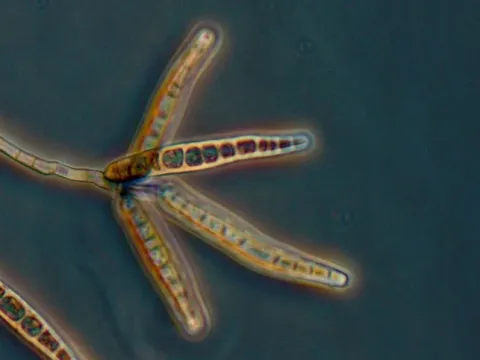
Exserohilum rostratum
Exserohilum rostratum
Exserohilum rostratum is a mitosporic fungus belonging to the order Pleosporales. It is a dematiaceous hyphomycete, meaning its spores and hyphae possess dark pigmentation.
What the section contains
Exserohilum rostratum
The fungus survives in soil and crop debris as mycelium or chlamydospores. It is morphologically similar to other genera like Helminthosporium and Bipolaris.
Laboratory identification relies on analyzing conidia structure. They are typically spindle-shaped or rostrate, multicelled, and feature a prominent, protruding hilum where they attach to the conidiophore.
Dissemination is primarily via conidia, spread by wind, rain splashes, and farm equipment. The fungus has a wide host range, making it a persistent threat to diverse agroecosystems.
It exhibits remarkable adaptability to varying environmental conditions, ensuring its survival even during harsh overwintering periods.
Exserohilum rostratum causes various diseases, including helminthosporiosis leaf spots, root rots, and spike infections. Major hosts include corn, millet, and rice.
Besides grasses, the pathogen affects dicotyledonous plants, such as cotton, various legumes, and vegetable crops. It is also known to cause leaf blight in turfgrasses.
The most severe damage occurs at the seedling stage, leading to damping-off or reduced stand establishment. In mature plants, it significantly impairs photosynthetic capacity.
Infection of reproductive organs leads to underdeveloped seeds, reduced seed weight, and decreased overall crop yield. Blanking or partial grain filling is a common consequence.
Contaminated seeds may harbor mycotoxins, severely impacting grain quality and making the crop unsuitable for food or feed processing.
Disease development is favored by warm and humid conditions. The optimal temperature for conidia germination ranges from +22°C to +30°C.
High relative humidity (above 80-85%) is the critical driver for mass infection and the development of epidemics, particularly during rainy seasons.
Primary inoculum arrives from infected seeds or overwintered crop debris. The fungus spreads rapidly to healthy foliage as the season progresses.
Secondary infections occur repeatedly throughout the growing season whenever free moisture is present on the leaf surfaces.
As the season ends, the fungus produces resilient chlamydospores, allowing it to persist in the soil and remain viable until the next planting season.
Symptoms appear as spots of varying shapes, ranging from oval to elongated, usually brown or dark-colored. Often, these spots are surrounded by a yellow chlorotic halo.
Under humid conditions, a gray or olive-black velvety growth emerges on the lesions, which is the fungal sporulation layer.
Root infection causes tissue blackening and decay, eventually leading to plant wilting. Necrotic stripes may also appear on the lower stems.
On corn cobs, the infection manifests as a grayish fungal mat that gradually decays kernels, making them brittle and darkened.
Field symptoms can mimic nutrient deficiencies or other leaf spots, necessitating professional diagnostic analysis for confirmation.
Cultural practices form the foundation of control, particularly crop rotation (2-3 years without susceptible hosts) and deep plowing to bury crop residues.
Using high-quality, treated seed is essential to prevent early-season infection from soil-borne pathogens.
Fungicide applications, including triazoles, strobilurins, or benzimidazoles, are effective when applied based on disease scouting and weather forecasts.
Managing weeds that act as alternative hosts is a crucial step in reducing the overall inoculum pressure in the field.
Breeding and planting resistant varieties remain the most sustainable and economically viable strategies to mitigate the impact of Exserohilum rostratum.