
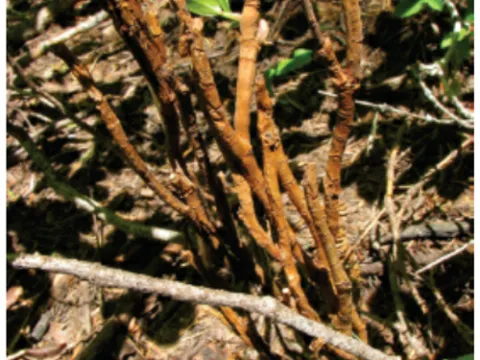
Exobasidium perenne
Exobasidium perenne
Exobasidium perenne is a fungal pathogen belonging to the Exobasidiaceae family. It is a highly specialized parasite that primarily targets plants within the Ericaceae family, particularly lingonberries (Vaccinium vitis-idaea).
What the section contains
Exobasidium perenne
The term 'perenne' refers to the fungus's ability to persist as mycelium within the host plant's tissues over multiple growing seasons. This perennial nature makes it a persistent threat in berry production.
The pathogen does not develop distinct, fleshy fruit bodies. Instead, it forms a microscopic layer of basidia directly on the surface of the infected plant parts, which produces spores for further reproduction.
Its biological cycle is intricately linked to the host plant’s phenology. The mycelium remains dormant during winter and resumes activity as the plant begins its spring growth cycle.
Due to its endophytic growth habit, the fungus can reside within the plant for long periods without showing obvious external symptoms, complicating early detection and management efforts.
The primary damage caused by Exobasidium perenne involves the formation of hyperplastic growths, or galls, on the leaves and stems of lingonberries. This disrupts the plant's normal metabolic processes.
The pathogen interferes with the host's ability to photosynthesize effectively by deforming leaf tissues. This leads to a reduction in carbohydrate accumulation, which is essential for berry development.
Economic impact is significant, as the infection causes severe yield losses. Infected plants show reduced vigor, stunted growth, and eventually, a decline in the number of marketable berries produced per season.
The disease tends to spread in patches within a field. If left unmanaged, the infection can move from plant to plant, weakening the entire patch and shortening the lifespan of the plantation.
Additionally, the weakened plant tissues become more susceptible to secondary infections by other opportunistic pathogens, further complicating the recovery process for the host.
Initial symptoms include the appearance of pale, yellowish, or reddish patches on the leaves. As the infection progresses, these areas thicken and become distorted, forming visible galls.
During periods of high humidity, a thin, white powdery layer develops on the underside of the infected leaves. This layer consists of the fungus's reproductive spores, which are easily wind-dispersed.
Stems may also show signs of infection by becoming curled or twisted, deviating from their natural growth direction. In severe cases, the entire shoot development may be arrested.
Infected leaves are often prone to premature shedding. This loss of foliage significantly impacts the plant's energy production capacity and can leave the bush vulnerable to drought stress.
- Visible thickening and distortion of leaves.
- Pinkish or reddish discolorations on foliage.
- White, powdery spore masses on the undersides of leaves.
- Stunted and twisted stem growth.
- Premature defoliation of infected bushes.
The cornerstone of management is rigorous sanitation. Removing and destroying all infected plant parts early in the season is crucial to reduce the primary inoculum load in the field.
Copper-based fungicides are commonly utilized to manage the spread of the pathogen. Timely application, particularly before bud break, helps protect healthy tissues from incoming spore infection.
Managing the microclimate is also vital. Reducing canopy density through proper pruning improves airflow, which keeps foliage drier and inhibits the conditions necessary for spore germination.
Continuous monitoring of the berry patch is required. Early identification allows for localized treatment or removal of infected plants, which prevents the disease from reaching epidemic levels.
Finally, sourcing high-quality, disease-free planting material is essential when establishing new fields. Avoiding the introduction of the fungus is far more effective than trying to eradicate it once established.