
Exserohilum halodes
Exserohilum halodes
Description
How to identify
Exserohilum halodes is a fungal plant pathogen belonging to the Ascomycota division. It is recognized as a significant agent responsible for various leaf spot diseases in a diverse array of cultivated crops.
The fungus propagates through conidia, which are efficiently dispersed by wind and splashing rain. Its biological cycle is characterized by rapid colonization of host tissues when environmental conditions remain favorable.
The pathogen persists in the soil and on crop debris as mycelium or chlamydospores, acting as the primary source of infection for subsequent growing seasons if sanitation is not maintained.
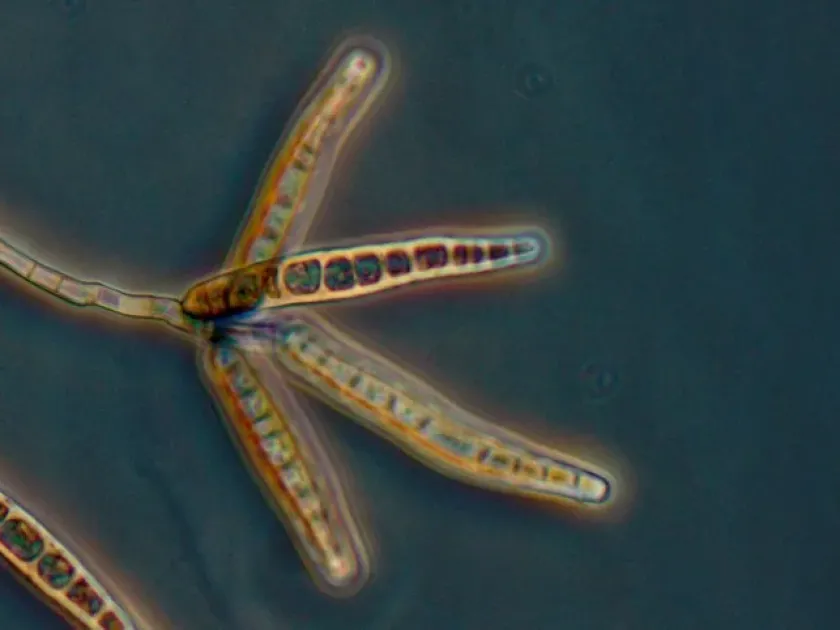
Microscopic examination reveals dark, multiseptate, fusiform conidia with a prominent protruding hilum, which serves as a definitive diagnostic feature for mycological laboratory identification.
As a member of the Exserohilum genus, it shares evolutionary traits with other related pathogens, yet it maintains specific virulence profiles that target particular agricultural hosts effectively.
What it damages
This pathogen primarily targets leaves, causing significant physiological damage by impairing the plant's ability to perform photosynthesis, which is critical for growth and development.
In addition to foliage, the fungus can infect stems and petioles, leading to structural weakening and potentially causing the plants to lodge or wilt under environmental stress.
The severity of the damage directly correlates with the timing of infection; early-season outbreaks can lead to stunted plant growth and drastically reduced yields in affected fields.
Beyond quantity, the disease negatively impacts the quality of the harvested produce, which can be particularly damaging for crops where leaf or seed quality is a key market requirement.
Under heavy infection pressure, the lesions coalesce, covering large areas of the leaf surface, which can cause total senescence of the leaf tissue prematurely.
Signs of infestation
The disease typically begins as small, chlorotic spots that expand into characteristic brown or dark-colored necrotic lesions, often surrounded by a yellow halo.
A hallmark of Exserohilum halodes infections is the formation of concentric zones within the lesions, reflecting the fungal growth patterns over varying diurnal cycles.
High humidity promotes the development of a dark, velvet-like fungal mat on the surface of the lesions, which is the sporulation phase containing masses of conidia.
- Appearance of small circular to elongated spots on leaf blades.
- Dark necrotic centers with alternating light and dark bands.
- Wilting and necrosis starting from the leaf tips or margins.
- Premature leaf drop following extensive infection.
- Presence of darkened, irregular streaks on stalks and stems.
Visible symptoms often progress rapidly from the lower, older leaves to the upper foliage, especially in crops with dense canopies that trap humidity near the ground.
Control measures
Effective management begins with robust crop rotation practices, ensuring that non-host crops are planted in affected fields for several years to deplete the pathogen's soil population.
Deep plowing or incorporating crop residues into the soil is essential to accelerate decomposition and reduce the amount of inoculum available for future infection cycles.
Utilizing high-quality, treated seeds is a critical preventative measure that protects young seedlings during the most vulnerable stages of their development.
When environmental conditions favor disease development, the application of systemic fungicides, specifically those containing triazoles or strobilurins, provides reliable control.
Balanced fertilization, particularly adequate potassium levels, plays a vital role in strengthening plant cell walls and enhancing the host's natural defense mechanisms against fungal penetration.
Causes diseases · 1
Discussion
No discussions yet — be the first.